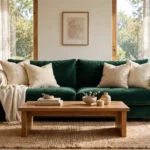

The first apartment I ever rented had walls the color of old oatmeal and carpet I was afraid to look at too closely. I stood in the middle of that empty beige box on move-in day, surrounded by boxes and one very sad futon, and opened Pinterest. Two hours later I had forty saved pins and absolutely no idea where to start. Everything looked incredible on my phone screen and completely impossible in my actual 600-square-foot rental with its strict no-paint lease.
Here’s what I wish someone had told me that afternoon: a cool apartment aesthetic has almost nothing to do with square footage or budget. It comes from a handful of decisions — a color palette you actually stick to, lighting that isn’t the sad ceiling fixture, textures you can feel, and a few personal things that make the place look like a human lives there instead of a furniture showroom. I learned all of this the slow, expensive way, one regrettable impulse purchase at a time.
These are the ideas that genuinely worked in my rentals over the years. Every single one is renter-friendly, most of them cost less than a takeout habit, and none of them require power tools or landlord negotiations.
Start With Three Colors, Not Three Shopping Carts
My biggest early mistake was shopping before deciding what I liked. I’d buy a sage green throw pillow because it was cute, then a mustard lamp because it was on sale, then a navy rug because the reviews were good. The result was a living room that looked like a clearance aisle. Cute items, zero chemistry.
Pick three colors before you buy anything else: one main neutral (warm white, greige, charcoal — whatever feels like you), one supporting tone (a wood tone or a second neutral), and one accent you repeat everywhere. My current place runs on warm white, walnut brown, and olive green. The olive shows up in a plant pot, two pillow covers, and a thrifted art print. That’s it. But because it repeats, the whole apartment looks intentional.
Take a screenshot of your palette and keep it on your phone. When you’re standing in a store holding something tempting, check it against the screenshot. If it doesn’t match at least loosely, put it back. This one habit will save you more money than any sale.
The Moody Wall Trick (Yes, Renters Can Do This)
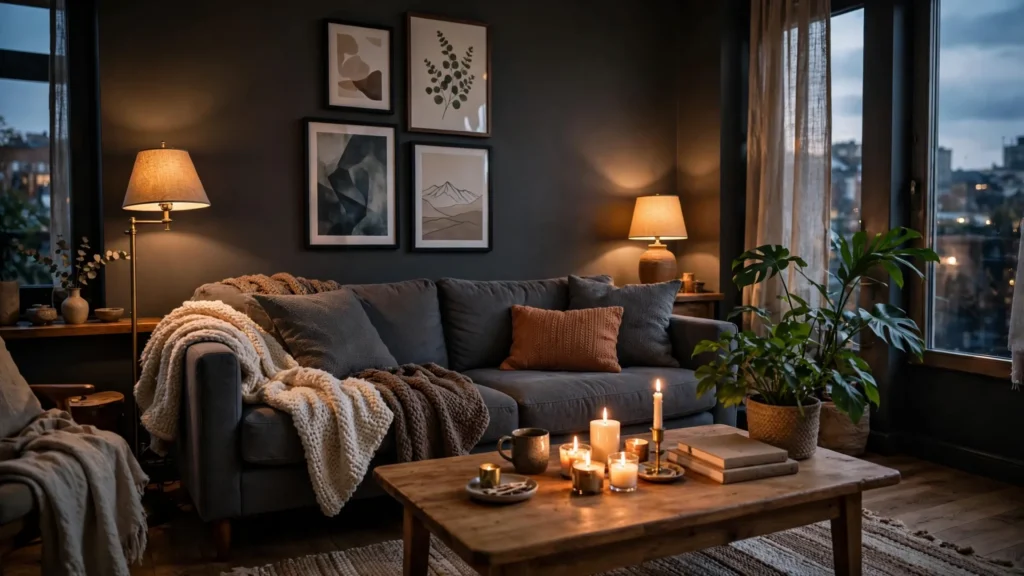
Everyone assumes moody, dramatic interiors require painting walls a landlord-forbidden shade of charcoal. Not true. You can fake the entire vibe with one large piece of dark furniture, warm lighting, and something dark on the wall that isn’t paint — a big framed print with a dark background, a peel-and-stick wallpaper panel behind the sofa, or even a dark tapestry.
My living room’s “moody corner” is a charcoal loveseat I found secondhand, a floor lamp with a warm-toned shade, and a gallery of dark-framed art above it. At night, with the overhead light off, that corner looks like a completely different apartment. The secret is warm-white bulbs — 2700K, never daylight. Cool bulbs on dark colors make everything look like a parking garage. Warm bulbs make it look like a cocktail bar.
Texture Is the Whole Game in a Neutral Apartment
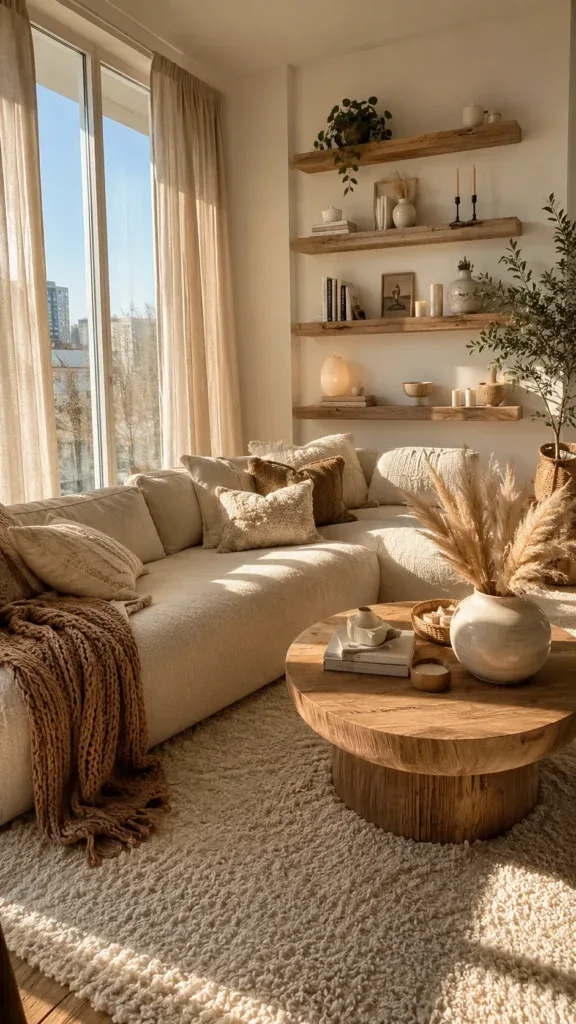
If your palette is mostly creams, beiges, and soft whites, texture is what keeps it from looking flat and boring. This is the difference between a neutral room that looks expensive and one that looks unfinished. Mix linen, chunky knit, bouclé, jute, oak, and ceramics. Your eye reads all those different surfaces as visual interest, even when everything is technically the same color.
The trap to avoid: buying everything in the exact same shade of beige. It photographs as one big oatmeal blob. Layer cream, sand, taupe, and warm brown together instead. My sofa is cream linen, the throw is a chunky oatmeal knit, the baskets are natural seagrass, and the coffee table is honey oak. Four different “beiges,” and the room has more depth than most colorful rooms I’ve seen.
A quick texture checklist
Walk through your main room and count textures. If you have fewer than five distinct ones (fabric, wood, metal, glass, plant, woven, stone), add the missing ones with small things first — a woven basket, a ceramic vase, a nubby pillow cover. Small swaps, big payoff.
Industrial Style Without the Warehouse Vibe
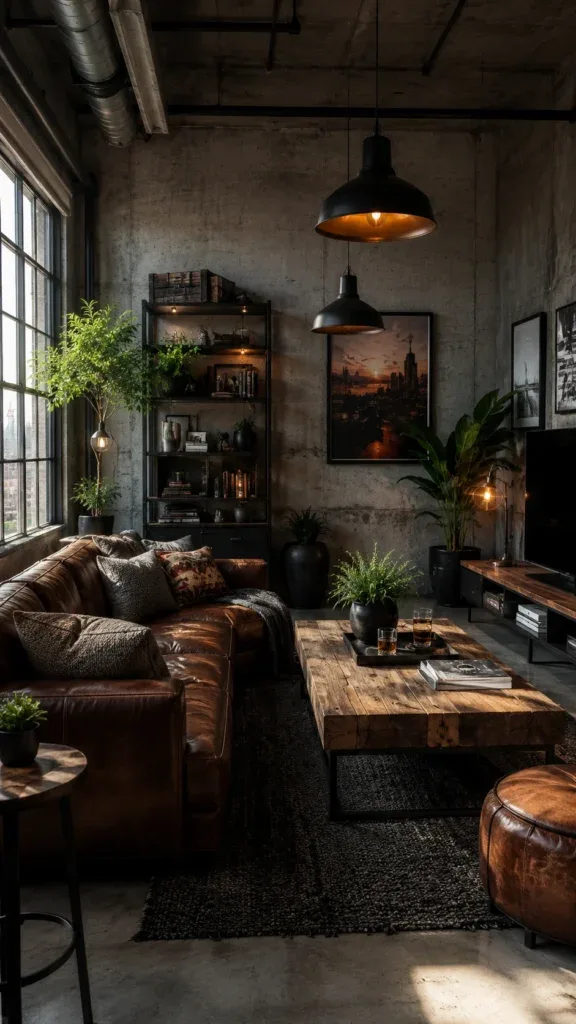
Industrial decor — black metal, leather, concrete, reclaimed wood — looks incredible in photos and freezing cold in real life if you go all in. The fix is balance. Keep the raw materials as your backbone but soften every hard surface with something warm: a thick rug under the metal coffee table, a knit throw on the leather sofa, curtains instead of bare windows.
I have a friend whose loft apartment nailed this. Exposed ductwork, concrete floors, a black metal shelving unit — and then the coziest cream rug you’ve ever stood on, linen curtains, and about six candles. The industrial bones made it look cool; the soft stuff made it a place you actually wanted to sit down in. Pick one industrial hero piece per room and let everything else soften it.
Scandinavian Simplicity: Own Less, But Better
Scandinavian style gets misunderstood as “buy white furniture.” It’s really a philosophy: every item earns its spot. In a small apartment, this mindset is gold. Before I adopted it, my shelves were packed with little decorative objects I’d collected over the years, and the whole place felt cluttered no matter how much I cleaned.
Try the open-space rule: leave actual empty space on every shelf and surface. A shelf with three objects and breathing room looks designed; a shelf with twelve objects looks like storage. Pick the few things that matter — the plant, the framed photo, the weird little ceramic thing from your trip — and give them room. Your apartment will feel bigger overnight, and you won’t have spent a cent.
Japandi Made My Living Room Feel Twice as Calm
Japandi — Japanese minimalism meets Scandinavian warmth — is the aesthetic equivalent of a deep breath. Low-profile furniture, muted earthy tones, natural materials, and ruthless restraint with decor. When I swapped my bulky armchair for a low wooden lounge chair and cleared two-thirds of my coffee table styling, the room genuinely felt calmer. Guests noticed before I even mentioned it.
The key word is restraint. Every object should feel chosen. If you’re doing Japandi and your shelf still has eight things on it, remove five. The style only works when there’s room for the few pieces to be appreciated. Natural imperfections — the grain in the wood, a handmade ceramic with a slightly uneven glaze — aren’t flaws here, they’re the whole point.
Stop Ignoring Your TV Wall
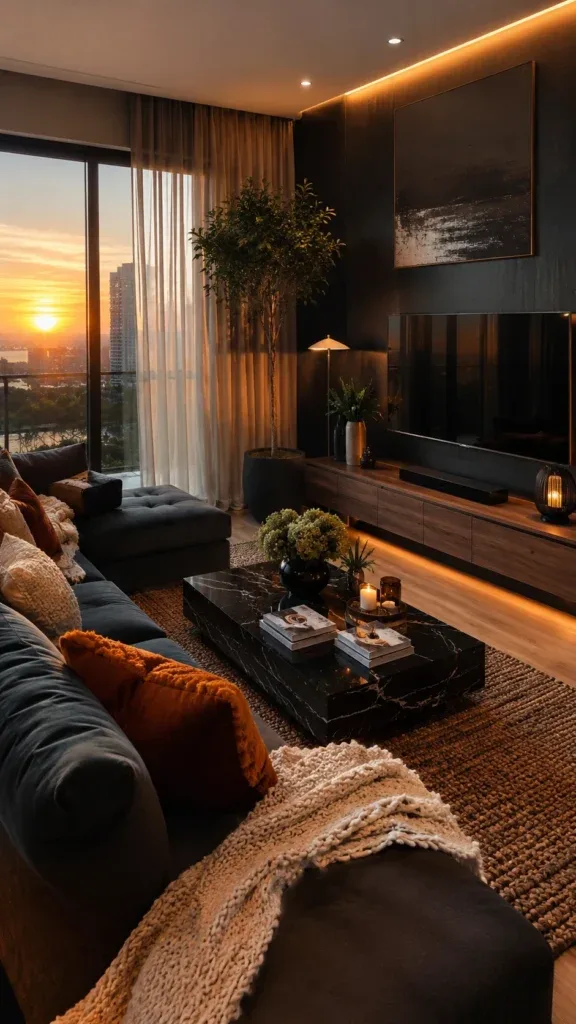
Here’s a hard truth: the TV is usually the biggest visual object in the room, so pretending it doesn’t exist never works. Treat the wall around it like a design feature instead. A floating console underneath, a couple of vertical elements on the sides (tall plant on one side, floor lamp or slim bookshelf on the other), and — the cheapest upgrade of all — hiding every visible cable.
I spent one Saturday afternoon mounting a simple floating shelf under my TV, adding a wood-slat panel from peel-and-stick slats, and running cables through a $10 cord cover painted the wall color. It looked like a $2,000 media wall. Nobody believes me when I tell them the total was under eighty bucks. If you do nothing else in this article, hide your cables. It instantly makes any setup look expensive.
The Plant Strategy That Actually Survives Real Life
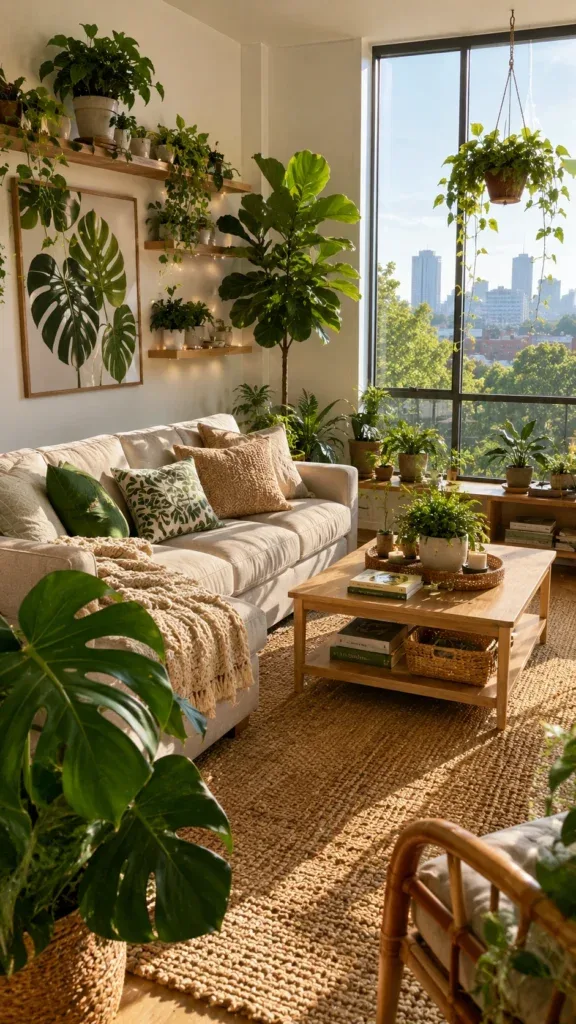
Plants are the fastest way to make an apartment feel alive, but the graveyard of dead fiddle-leaf figs in my past tells a story. The strategy that finally worked: start with plants that forgive you. Pothos, snake plants, ZZ plants — the ones that thrive on neglect. Buy three, not fifteen.
Then group them. One lonely plant on a windowsill looks like an afterthought; a cluster of three to five plants at different heights looks like a design decision. Put the tall one in the corner, a trailing one on a shelf, a small one on the coffee table. Use matching or coordinated pots — mismatched plastic nursery pots undo all the good work. I keep a watering can by the sink as my reminder system, and I’ve kept everything alive for two years now, which is a personal record.
Build a Reading Corner in Six Square Feet
You don’t need a big apartment for a reading nook — you need a corner and about $60. Mine is a secondhand armchair angled toward the window, a small side table for tea, and a floor lamp with a warm bulb. It occupies maybe six square feet of what used to be dead space next to the bookshelf, and it’s the most-used spot in my home.
The non-negotiables: light you can read by (a floor lamp positioned over your shoulder, not across the room), a surface within arm’s reach, and a throw blanket. Skip the throw and you’ll never use the corner in winter — trust me, I learned this in January. Keep your current book on the side table and the corner will pull you in every evening.
Warm Wood Fixes Almost Everything
If your rental feels cold or sterile, warm wood is the fastest fix. Oak, walnut, honey-toned pine — wood instantly adds warmth and a sense of permanence that rental-white walls lack. Start with the biggest piece you can: a coffee table, a bookshelf, a dining table. Then echo the tone in smaller pieces.
One rule that changed my space: don’t match your wood tones exactly. A room where every wood piece is identical looks like a furniture set from a warehouse store. Mix honey oak with darker walnut and it looks collected over time, like a real home. Keep walls light and neutral so the wood has room to glow instead of competing with bold paint.
Gallery Walls Without the Drill Anxiety
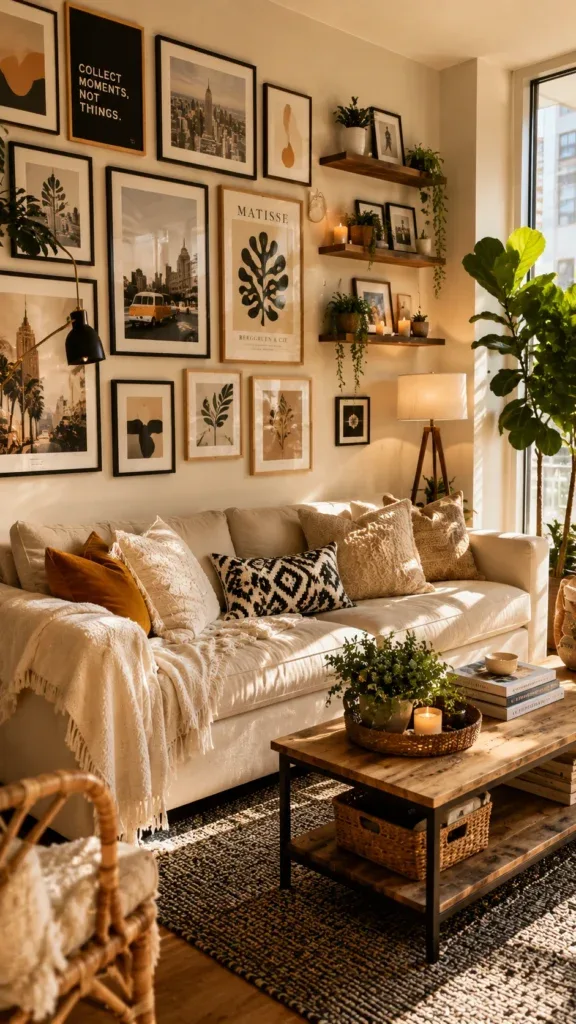
A gallery wall is the single best way to make a rental feel like yours, and modern adhesive strips mean you don’t need to drill a single hole. The method that actually works: lay the whole arrangement on the floor first and live with it for a day. Take a photo. Rearrange. Then hang.
Keep 2-3 inches of consistent spacing between frames — this is the detail that separates “curated” from “chaotic.” Mix frame sizes but keep the frames themselves in one or two finishes. And include something personal: your own photos, a concert ticket, a postcard from a friend. A gallery wall of only store-bought prints looks like a hotel lobby. Yours should look like you.
Lighting Layers: The Cheapest Transformation There Is
If I could only give one piece of apartment advice, it would be this: turn off the overhead light and never look back. Overhead lighting is flat, unflattering, and makes every room feel like an office. The entire mood of an apartment changes when you switch to layered light — a floor lamp in the corner, a table lamp on the console, a couple of candles, maybe a small lamp on a bookshelf.
Place light sources at three different heights: something low (candles, a small table lamp), something mid (table lamps), something high (floor lamp or wall sconce). Use warm-white bulbs everywhere. Put the main ones on cheap plug-in dimmers or smart bulbs. My living room at 8pm — lamps glowing, candles lit, overhead off — looks like a different, much more expensive apartment than the same room at noon. Total cost was maybe $90 spread over a year.
A Dining Setup That Earns Its Floor Space
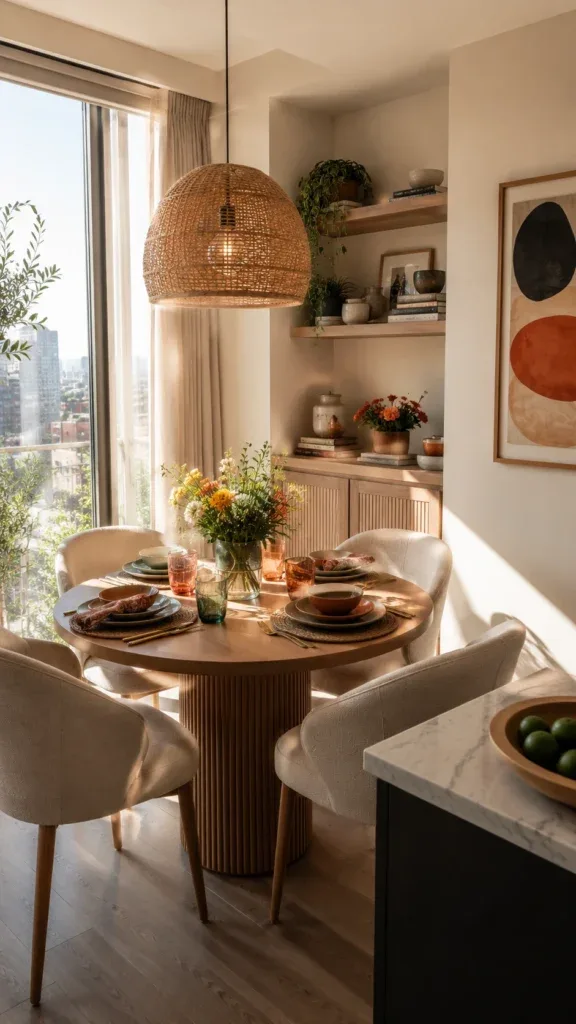
Small apartments and dining areas have an awkward relationship. A big rectangular table eats the room; no table means eating on the couch forever. The sweet spot is a small round table. Round tables seat more people than you’d expect, they improve traffic flow in tight spaces, and they look intentional rather than like a compromise.
Add one pendant light centered above it — even a plug-in pendant with a pretty shade — and suddenly it’s a dining room, not just a table shoved in a corner. Keep the chairs slim and, if you’re really tight on space, choose ones that tuck fully under the table. A tiny centerpiece (a small plant, a candle) signals “this is a real dining spot” to your brain, and you’ll actually use it.
Let It Look Like YOU Live There
The apartments I remember most aren’t the most stylish ones — they’re the ones that told me something about the person. The travel souvenirs on the shelf, the stack of well-worn cookbooks, the slightly crooked handmade pottery. These personal layers are what separate a cool apartment from a catalog page.
Build this slowly. Don’t buy all your “personality” in one shopping trip — that’s how you end up with decor that means nothing to you. Add things as you find them: the print from the local artist, the vase from the flea market, the framed photo that makes you laugh. Edit regularly, rotate things seasonally, and only display what you genuinely like. Your apartment should feel collected, not decorated.
Mistakes I Made So You Don’t Have To
Buying furniture before measuring
The classic. I once bought a gorgeous sofa online, and it physically did not fit through my apartment door. Measure your doorways, hallways, elevator, and the actual room — then measure again. Tape the footprint on the floor with painter’s tape before ordering anything big. Oversized furniture is the fastest way to make a small apartment feel cramped and stressful.
Buying matching sets
The bedroom set, the living room set — they look coordinated in the store and flat in real life. Rooms need contrast to feel designed. Mix your big pieces: different wood tones, different fabric textures, old mixed with new. Thrift stores and Facebook Marketplace are perfect for this, and your wallet will thank you.
Decorating with only overhead lighting
I lived for a year wondering why my apartment felt cold despite nice furniture. The answer was the ceiling light. Lamps first, always. If your budget is tight, buy lamps before you buy wall art — lighting changes the room more than anything hanging on the walls.
Filling every surface
Empty space is a design element, not a problem to solve. If every shelf, table, and counter is covered, the eye has nowhere to rest and the whole place feels cluttered no matter how nice the objects are. Remove a third of your decor and see what happens. You can always add back the pieces you miss.
Quick Answers
How can I make a small apartment look more expensive on a budget?
Layered lighting, cohesive colors, and hidden clutter do 80% of the work. Swap cool bulbs for warm ones, hide cables and cords, use matching storage baskets instead of visible piles, and keep surfaces mostly clear. None of this costs much, and together it reads as “expensive.”
What colors work best for a cool apartment aesthetic?
Warm neutrals are the safest base — cream, greige, warm white, soft beige — with depth from charcoal, olive green, walnut brown, or black accents. Pick three and repeat them. Trendy colors are fine as accents (pillows, art) but risky as big commitments in a rental.
How do I decorate without losing my security deposit?
Stick to things you can take with you: rugs, curtains, lamps, freestanding shelves, art hung with adhesive strips, peel-and-stick wallpaper, and removable wall panels. Avoid drilling, painting, and anything adhesive that isn’t rated for clean removal. Photograph everything on move-in day so you have proof of the original condition.
Can I mix different aesthetics in one apartment?
Absolutely — most interesting apartments do. The trick is one connecting thread: a repeated color, a consistent wood tone, or a shared metal finish. My place mixes Scandinavian simplicity with moody corners and industrial touches, and the repeated walnut and olive tones hold it all together.
Here’s the thing nobody tells you about apartment aesthetics: the goal was never a perfect Pinterest photo. The goal is walking through your front door after a long day and feeling like the space is on your side. Start with the palette, fix the lighting, add texture, and let the personal stuff accumulate naturally. Six months from now, you’ll look around and realize the beige box is gone — and you did it one small, smart decision at a time.
If you try any of these ideas, I’d love to hear which one changed your space the most. The lighting trick is my bet — it gets everyone.