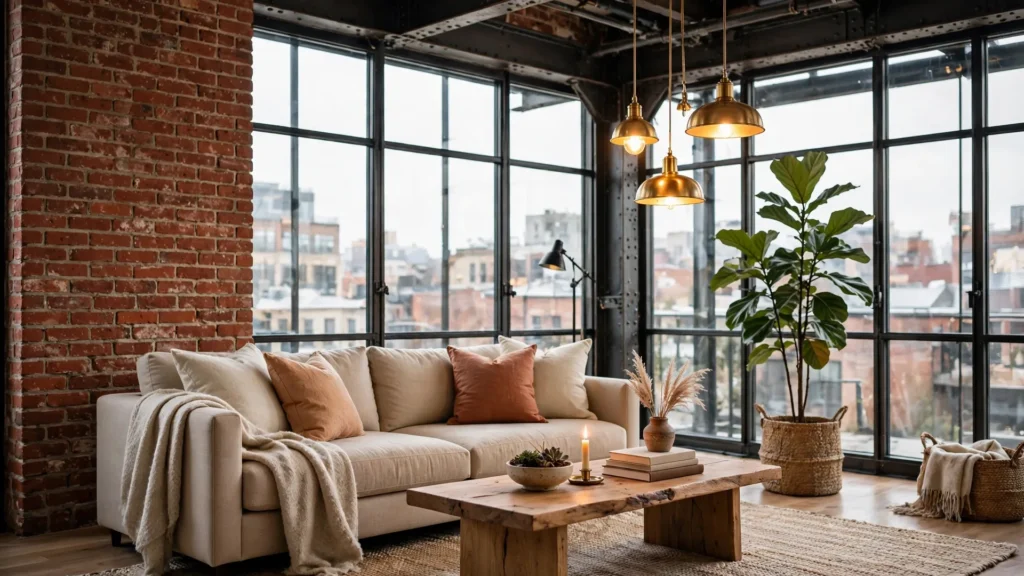

The first time I walked into a real loft apartment, I was sold before I’d even taken my shoes off. Twenty-foot ceilings, a wall of black steel windows, that gorgeous worn brick. And then I spent twenty minutes in it and my stomach dropped a little. It was loud. Every footstep echoed. It felt like standing in a really beautiful warehouse, which, of course, is exactly what it was.
My friend lived there, and over the next year I watched her turn that echoey shell into the warmest apartment I’ve ever hung out in. I stole every trick she used. Then I moved into a much smaller place with the same industrial bones and made every mistake she hadn’t — too-small rugs, matching furniture sets, a pendant light that looked like a Christmas ornament hanging from a cathedral ceiling. So when I tell you these 13 loft apartment aesthetic ideas work, it’s not from a mood board. It’s from trial, error, and one very embarrassing rug situation.
The thing about lofts is that the architecture does half the work for you. The hard part is the other half: making all that openness feel like a home instead of an event space.
1. Let the brick be the main character
If you’re lucky enough to have exposed brick, resist the urge to decorate over it. I once saw a loft where the owner had filled their one beautiful brick wall with floating shelves, four small prints, a clock, and a string of photo clips. The brick — the thing people would have paid extra for — disappeared.
Pick the strongest wall and give it room to breathe. Pull the sofa or the bed in front of it instead of against it, hang one oversized piece of art or a big mirror, and light it with a warm picture light or an adjustable wall lamp. At night, directional light on brick is unreal — the texture comes alive and you basically have a fireplace wall without a fireplace.
Warm wood furniture looks best against brick. A walnut coffee table, oak shelves, leather chairs — they all pick up the warm tones in the masonry. Cool gray metal everything will make red brick look angry instead of inviting.
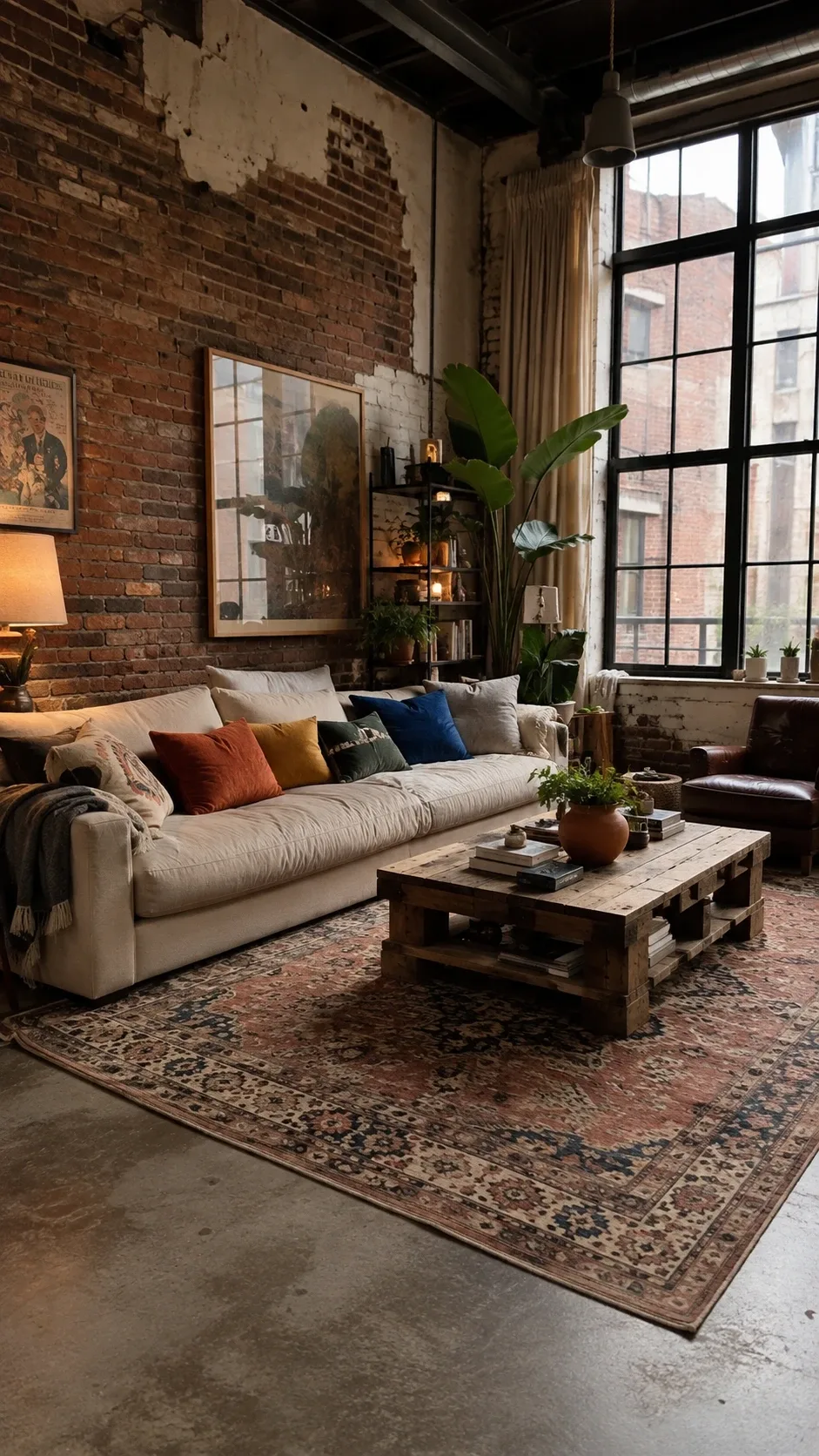
Image credit: homedishy.com
2. Buy the rug bigger than you think
This is the mistake almost everyone makes, and I made it twice. In a loft, a rug that would be generous in a normal apartment looks like a postage stamp. Under-scaled rugs chop an open floor into sad little islands and make the whole space feel unfinished.
Measure the zone first, not the floor. Lay out your furniture the way you actually want it, then buy a rug big enough that at least the front legs of the sofa and chairs sit on it. In a loft living area that’s often an 8×10 or 9×12, which feels insane until you see it down. Suddenly the seating area reads as one intentional room instead of furniture floating in a hangar.
Wool, jute, or a good vintage-style washable rug all add softness against concrete and brick. Pick one with two or three colors from your accent palette and let it do the connecting work between pieces you bought years apart.
3. Drop in one bold sofa and keep everything else calm
A loft can swallow small gestures whole. One confident piece of color — an emerald velvet sofa, a burnt-orange loveseat, a deep blue sectional — gives the entire room a focal point and instantly makes the space feel designed rather than accidental.
The key is discipline everywhere else. When the sofa is the color, the rug, curtains, and side tables should be quiet. I learned this the expensive way: I paired a rust-colored sofa with a patterned rug AND mustard chairs AND terracotta curtains, and my living room looked like a spice market having a panic attack. One star, strong supporting cast.
Before you commit, get fabric swatches and look at them in the loft’s actual light. Those giant windows change everything throughout the day — a color that looks rich at noon can go muddy at dusk.

Image credit: homedishy.com
4. Layer your lighting like you mean it
Lofts punish single-source lighting. One sad ceiling fixture in a twenty-foot space just highlights how cavernous everything is. What works is the three-level rule: something overhead, something at eye level, and something low.
High ceilings are your excuse for dramatic pendants — a cluster of globe lights over the dining table, one oversized dome pendant in the living zone, a long linear light over the kitchen island. Then floor lamps and table lamps for the middle layer, and a few small accent lights (a candle cluster, a tiny lamp on the shelf, LED strips behind the bookshelf) for the glow that makes it feel like evening.
Two practical notes. First, scale your pendants UP. A pendant that looks bold in the store will vanish against a high ceiling; if it feels slightly too big in your hands, it’s probably right. Second, go warm — 2700K bulbs everywhere. Cool white light on concrete and steel is how you get a space that feels like a parking garage.
5. Soften the hard stuff with texture on texture
Loft architecture is a greatest-hits album of hard surfaces: concrete, brick, steel, glass. The fix isn’t removing any of it — it’s balancing it with softness until the contrast feels good. Think linen curtains, a chunky knit throw, a wool rug underfoot, woven baskets, a leather chair that’s broken in.
The trick I wish someone had told me earlier: repeat each texture in more than one spot. One lonely throw pillow doesn’t soften a room. But linen curtains plus a linen-upholstered bench, a jute rug in the living area plus a smaller jute runner in the entry, wood in the coffee table echoing wood in the shelf — that’s what makes a loft feel connected instead of like a furniture showroom.
6. Use oversized plants to fill the vertical space
Furniture tops out around three feet. Loft ceilings start around twelve. Tall plants are the easiest, cheapest way to bridge that gap. A bird of paradise, an olive tree, a big rubber plant, or a fiddle-leaf fig (the classic for a reason) adds height, life, and a soft organic shape against all those rectangles.
My honest advice: buy the plant for your light, not for your Pinterest board. That giant olive tree dies in six weeks in a north-facing loft corner and then you’re out eighty dollars with a stick in a pot. Check what direction your windows face, be honest about it, and ask the nursery — they love this question.
Put the big plants near windows and use smaller ones to step down toward lower furniture. And get real planters with some weight to them — terracotta, stone, heavy ceramic. A huge plant in a flimsy plastic pot looks like it’s wearing pajamas to a wedding.
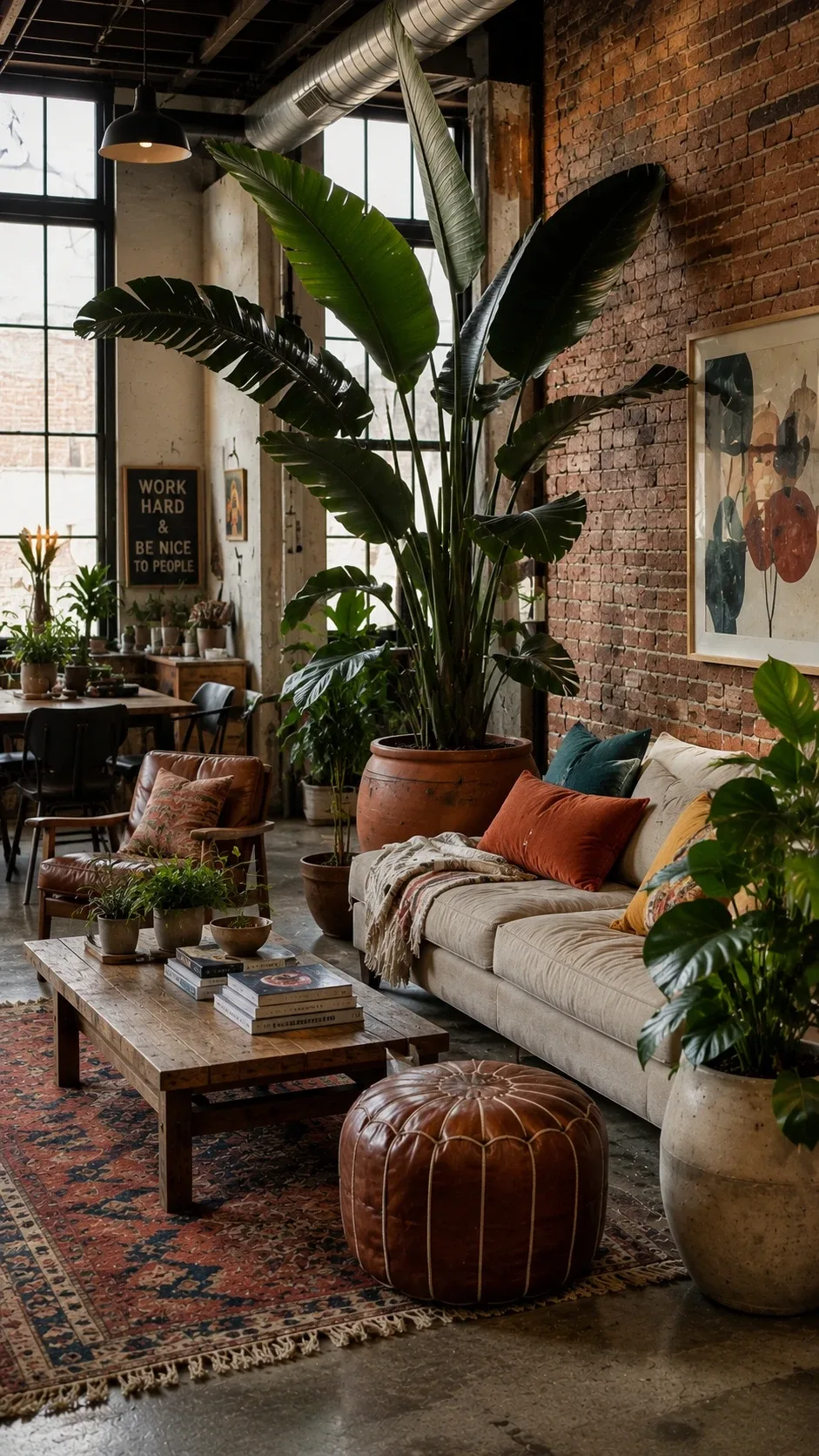
Image credit: homedishy.com
7. Divide space with open shelving, not walls
Walls are the enemy in a loft — the moment you build one, you’ve lost the thing that made the place special. Open shelving does the job of a wall without the heaviness. A tall bookcase set perpendicular to the room can separate a bedroom corner from the living area while letting light pass straight through.
The mistake is treating every shelf like a storage unit. Leave gaps. Let some shelves hold three books and a plant. Empty space on a shelf is what keeps it feeling like a divider and not a barrier. A mix of roughly two-thirds useful things and one-third pretty things keeps it honest.
If you have kids or pets, anchor tall units to the wall. A toppled bookcase in a loft is a long way to fall.
8. Mix vintage pieces with new ones
The best lofts I’ve been in look collected, not decorated. A modern sofa next to a beat-up wooden cabinet. A sleek dining table with secondhand chairs that don’t match. Industrial shelving holding handmade ceramics. That contrast is what gives a loft history.
You don’t need a flea-market obsession to pull this off. One genuinely old piece — a vintage rug, a farmhouse table, an antique mirror — does more than a room full of brand-new “industrial style” accessories. Repeat materials across the old and new pieces (the same oak tone, the same black metal) so the different eras feel like they chose each other.
9. Give the bedroom corner real boundaries
Sleeping in an open loft can feel exposed — like camping in your own living room. The fix doesn’t require construction. A ceiling-mounted curtain track around the bed creates a bedroom that closes at night and vanishes during the day. Heavy linen or velvet curtains absorb sound too, which is a gift in an echoey space.
Go big on the bed itself. A low, minimal frame disappears under high ceilings; a substantial headboard and layered bedding give the sleeping zone visual weight. One dark element behind the bed — a deep-toned curtain panel, a charcoal headboard — anchors the corner without darkening the whole loft.
10. Carve out an office nook instead of a home office
You don’t need a separate room to work from home in a loft. A slim desk against a wall, tucked under a window, or parked beside a structural column works perfectly — the column is actually ideal, because it gives your “office” a wall on one side without any construction.
The boundary is psychological, so make it visual: a small rug under the desk, a wall shelf above it, one good task lamp. And hide the cables on day one. Cables are the fastest way to make a loft nook look like a server room. A twenty-dollar cable tray and a power strip with a long cord will change your life.
11. Turn the big blank walls into a gallery wall
Huge empty walls are the number one reason lofts feel unfinished. But scattering small frames across twenty feet of wall just makes it look like you gave up halfway. Instead, commit to one concentrated gallery wall — art in different sizes clustered around one anchor piece, relating to the furniture below it.
Lay everything on the floor first and play with the arrangement before a single nail goes in. Keep the center of the whole composition at eye level, not centered on the wall’s height — hanging art at “loft center” is how you end up with pictures nobody can see. One repeated element, like the same wood frame or one recurring color, makes even a wild mix look intentional.
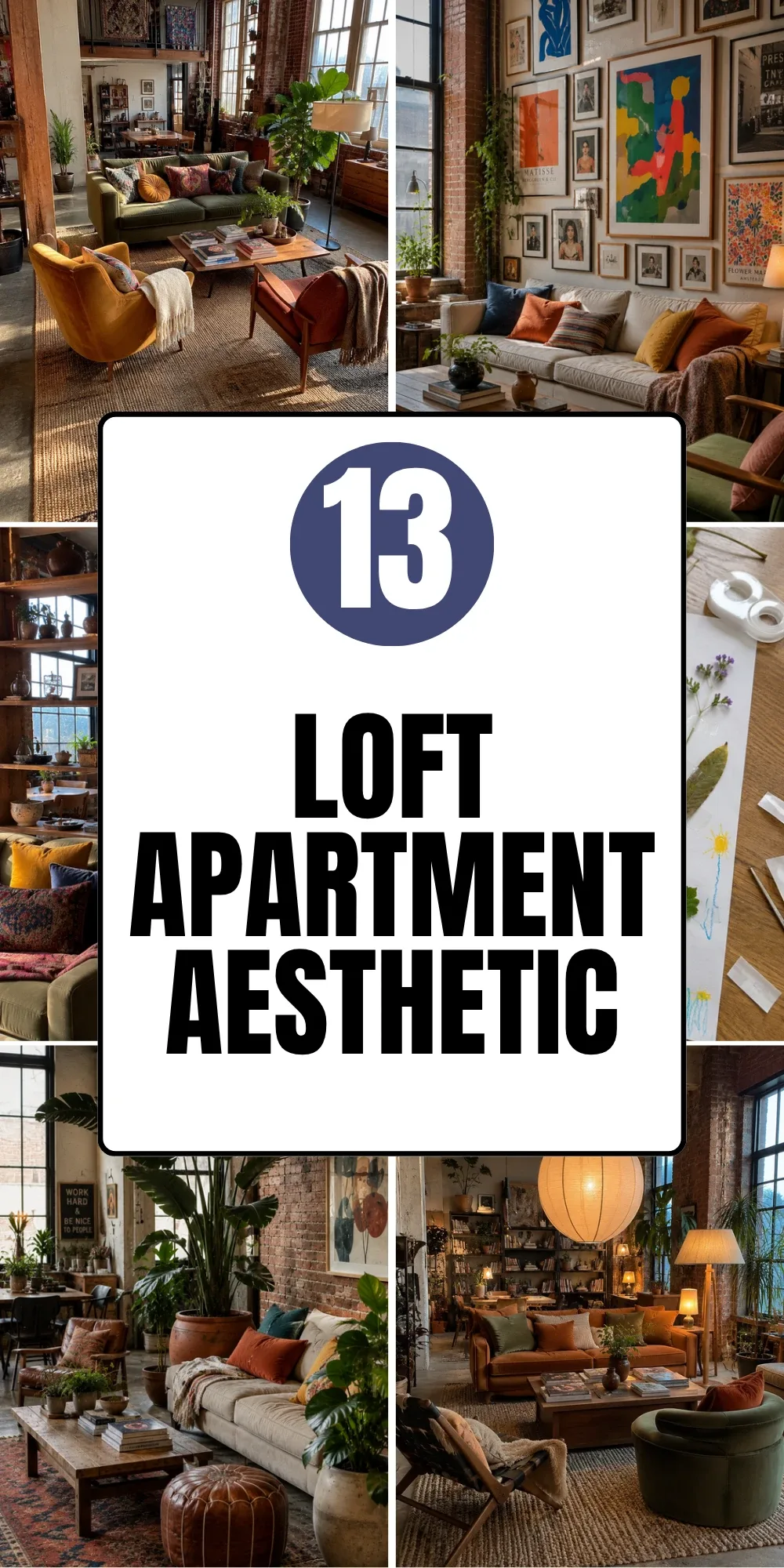
Image credit: homedishy.com
12. Build a conversation corner at human scale
A loft can seat twelve people and still feel lonely, because the furniture is spread so far apart that nobody can hear each other. Fix it with a dedicated conversation corner: two comfortable chairs angled toward each other, a small table between them, a floor lamp, a compact rug.
Place it slightly away from the TV zone so the loft supports more than one way of hanging out — someone reading, two people talking, a third person cooking nearby. A round table works especially well here; it softens a room that’s otherwise all rectangles — windows, beams, shelves, sofas.
13. Finish with warmth in the kitchen and dining zone
Open kitchens in lofts often get treated as an afterthought — the industrial bones carry them, so people leave them stark. But this is where you eat every day, so it deserves the same warmth. A big jute or washable runner under the island, a row of mismatched wooden stools, pendant lights hung low enough to actually light the counter, and open shelving with everyday dishes instead of a bare concrete wall.
My friend’s trick, which I now use in every kitchen: one warm thing at eye level. A wooden cutting board leaning against the backsplash, a small potted herb on the shelf, a copper pot hanging where you can see it. Tiny, cheap, and it completely changes how the kitchen feels at 7 a.m.
Mistakes to avoid in a loft apartment
Before you start, the short list of things that go wrong most often: rugs that are too small for the zone. Furniture pushed against every wall, which turns the middle of the room into a desert. Matching furniture sets — a loft with a full matching living room set looks like a furniture store, not a home. Cool-white bulbs. Tiny art on enormous walls. And decorating the brick wall into oblivion, which I mentioned, but it bears repeating because it’s so tempting.
Your first weekend: a 5-step loft warm-up
If you just moved in and the echo is getting to you, do it in this order. One, put down the biggest rug you can afford in the living zone — it’s the single fastest way to kill echo and define a room. Two, hang curtains on the biggest window wall, even cheap linen panels — fabric absorbs sound and softens light. Three, swap every bulb to warm 2700K and add one floor lamp. Four, bring in one big plant for the tallest empty corner. Five, hang one oversized piece of art on the largest blank wall. That’s a weekend, a few hundred dollars if you thrift the art and the lamp, and the loft will feel like a different apartment.
Final thoughts
A great loft apartment aesthetic isn’t about buying an industrial look off the shelf. It’s about respecting the bones — the brick, the steel, the windows, the height — and then layering in everything those bones lack: softness, warmth, color, and the slightly messy evidence that a real person lives there.
Start with one zone instead of trying to fix the whole apartment at once. Get the living area right, live with it for a couple of weeks, and then carry the materials and colors that worked into the next corner. That’s how lofts become homes — not in one shopping trip, but one good decision at a time.
You May Also Like
- poor apartment aesthetic ideas — 13 ways I made my tiny rental look charming on almost no budget
- creative handmade birthday card ideas — 13 cards I actually made (and what went wrong)
- birthday box ideas — 13 thoughtful DIY gift boxes that beat any store-bought present



Pingback: 13 Dorm Wall Decor Posters to Personalize Your Space (Renter-Friendly Ideas)
Pingback: Cool Apartment Aesthetic Ideas: 13+ Renter-Friendly Ways to Transform Your Space
Pingback: 27 Funny Work-From-Home Memes That Hit Way Too Close to Home
Pingback: Retro Apartment Aesthetic Ideas: 13 Cozy Ways to Get the Vintage Look