

Every December I hang the same red plaid curtains in our living room, and every December I forget how much of a difference they make until they are up. The whole room changes — the window stops being a cold rectangle of winter and turns into the warmest spot in the house. Christmas window curtains are one of those small swaps that do the work of a full redecoration, for the price of a pair of panels.
If your windows still look like October, this post will fix that. Below are seven Christmas window curtain ideas I have tried in my own home or helped friends with — from classic plaid to elegant velvet — plus the measuring and hanging tips that make the difference between curtains that look thrown up and curtains that look like a magazine photo.
Quick Answer Box: Christmas Window Curtains in a Nutshell
- The easiest festive look: red plaid curtains layered over white sheers with a string of fairy lights — classic Christmas in under half an hour.
- The most elegant option: deep green velvet panels with gold trim and a candlelit windowsill, perfect for a dining room or formal living room.
- The rule that matters: hang the rod high and wide — a few inches above the window frame and past the edges — so the window looks bigger and the curtains frame it instead of covering it.
Classic Red Plaid With Sheer Layers
This is the look in the photo above, and it is the one I come back to every year. Red plaid curtains tied back on each side, white sheer panels underneath, and a string of warm fairy lights woven along the top. The plaid gives you Christmas instantly, the sheers soften the light coming through, and the fairy lights make the whole window glow after dark.
The layering is what makes it work. Plaid on its own can look heavy and block a lot of daylight, which is the last thing you want in December when the days are already short. The sheers let the light through during the day, and at night you draw the plaid closed for warmth and privacy. Two layers, two jobs, one window.
For the tiebacks, use a thick rope or a velvet ribbon in a matching red, and tuck a small sprig of pine into each one. It costs nothing if you have a tree in the house — the trimmings from the bottom branches are perfect — and it ties the window into the rest of the room’s decorating. That little detail is what makes guests say the room feels “done” without knowing why.
Sheer White Curtains With a Pine Garland
If your style is light and airy rather than cosy and dark, start with sheer white curtains and dress up the rod instead of the fabric. Drape a pine garland with red berries across the curtain rod so it swags gently in the middle, and hang a few small gold stars from it on thin thread. The sheers stay bright and clean, the garland does the Christmas work, and the whole window still lets in every bit of winter daylight.

This is the best option for small rooms and kitchens, where heavy curtains would swallow the space. Sheers make a window feel bigger, and a garland adds the festive feeling without adding any bulk. It also works beautifully in a bedroom — you wake up to soft light through the sheers and the smell of pine, which is a lovely way to start a December morning.
A practical note: use a real garland if you can, or a good fake one with wired branches you can shape. The garland needs to sit on top of the rod and drape naturally — a stiff, flat garland looks like a shelf, not a swag. Fluff the branches out, let the middle dip lower than the ends, and step back to check it from across the room before you hang the stars.
Buffalo Plaid for a Farmhouse Window
Buffalo plaid — those big red and cream checks — is the farmhouse Christmas look, and it works best on windows with a bit of rustic character: wooden frames, a deep sill, a window seat. Tie the panels back with twine and tuck pine sprigs and a pinecone into each tieback, and put a chunky knit blanket and a mug of cocoa on the seat below. The window becomes the cosiest corner of the house.
Buffalo plaid is bold, so keep the rest of the window simple. Plain cream walls, a wooden sill, maybe a small garland along the bottom of the frame — that is enough. If you add patterned cushions and patterned throws and patterned everything else, the checks start fighting with the rest of the room. Let the curtains be the pattern and keep everything around them quiet.
This look is also one of the cheapest to pull off. Buffalo plaid panels are widely available and inexpensive, twine costs almost nothing, and the pinecones can come from the garden. If you only decorate one window this Christmas, make it this one — it photographs beautifully, which matters if your holiday cards or family photos happen in front of it.

Deep Green Velvet for a Formal Room
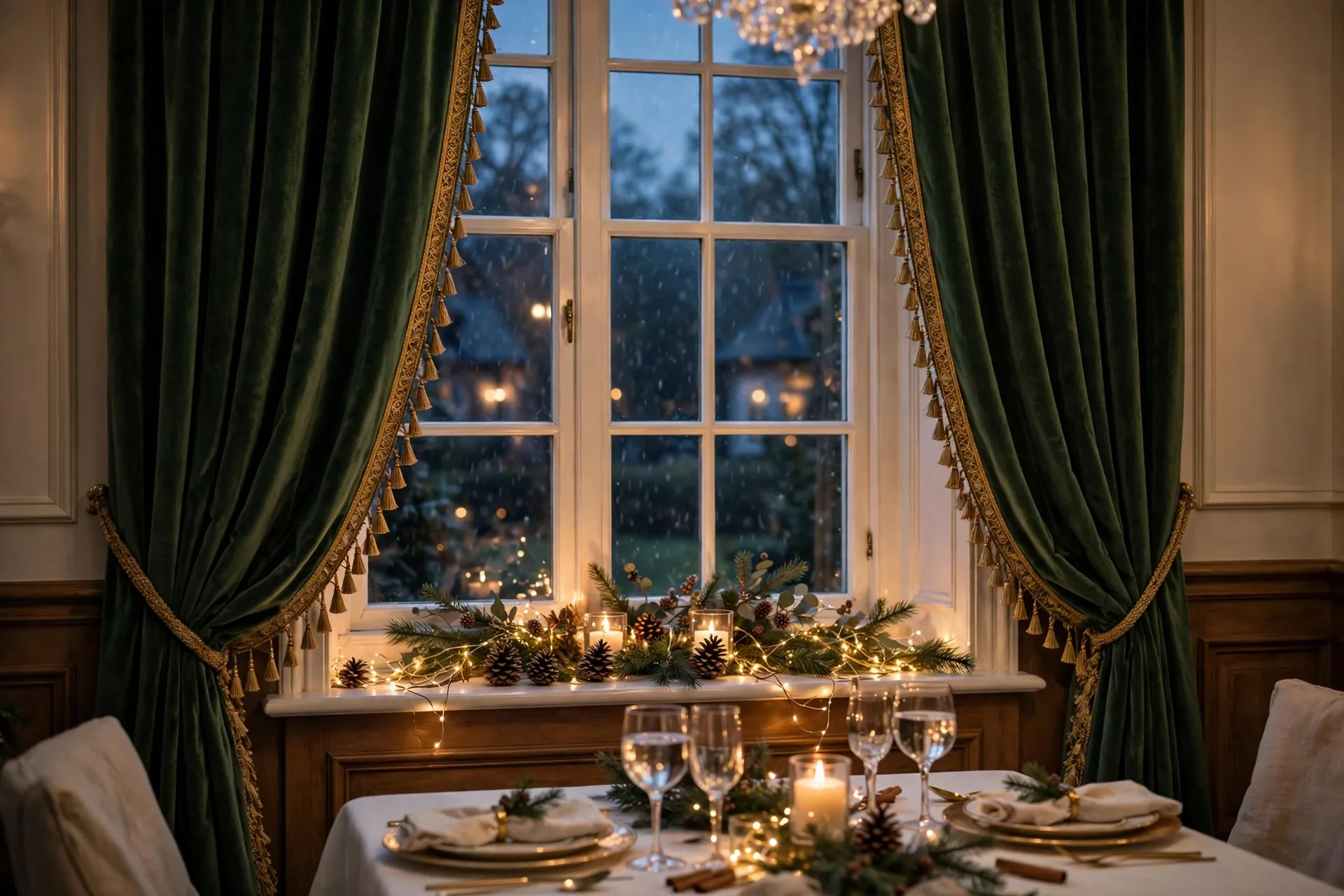
For a dining room or a formal living room, nothing beats deep green velvet. Floor-length panels in a rich forest green, trimmed with gold braid or tassels, turn an ordinary window into something that looks like it belongs in a Christmas film. Add a candlelit windowsill — pinecones, a little greenery, a few fairy lights — and the room is ready for Christmas dinner.
Velvet is heavy, so it needs a proper rod — a thick wooden or metal one with strong brackets, fixed into the wall rather than just the window frame. Hang the rod high, a few inches below the ceiling if you can, and let the panels pool very slightly on the floor or just brush it. Short velvet curtains look wrong; the drama is in the length.
The colour pairing matters here. Deep green loves gold, warm wood, and candlelight. Keep the rest of the room in those tones — gold cutlery, wooden furniture, cream napkins — and the window will feel like part of a set rather than a standalone statement. This is the most grown-up look in this list, and it is the one I would pick for hosting Christmas dinner.
Fairy Lights Woven Through Sheers
Here is the simplest idea on this list, and the one with the biggest payoff for the least effort. Take the sheer curtains you already own, and weave a string of warm white fairy lights through them — in and out of the fabric, or clipped to the back of the panel with small clear clips. When the lights are on, the whole window glows. When they are off, the curtains look completely normal.
Use battery-operated lights with a timer if your window is far from a socket, and choose warm white rather than cool white — cool white looks icy and a bit harsh, while warm white looks like candlelight. One string per panel is usually enough; two strings can look tangled rather than magical.
This works in every room, but it is especially lovely in a bedroom or a child’s room, where the glowing window becomes a night light of sorts. It is also renter-friendly — no holes, no new rods, no commitment. You can take the lights down in January and your curtains are just curtains again.
Natural Burlap and Pinecone Tiebacks
If plaid feels too traditional and velvet feels too formal, try the natural route. Plain linen or cotton curtains in cream or oatmeal, tied back with wide burlap ribbon, with a pinecone and a sprig of eucalyptus tucked into each tieback. Add a simple pine garland along the sill and you have a Christmas window that looks calm, natural, and a little bit Scandinavian.
This look is all about texture. Linen, burlap, pinecones, wood, dried orange slices — nothing shiny, nothing glittery, just natural materials that happen to look festive together. It suits modern homes and minimalist decorating better than any other idea here, because it adds warmth without adding colour or pattern.
The tiebacks are the key detail. A plain curtain pulled back with a burlap tie looks unfinished, but the same curtain with a pinecone and greenery tucked into the tie looks styled. Spend five minutes on each tieback and the whole window changes. Dried orange slices tied into the bow are another lovely touch, and they smell faintly of Christmas for weeks.
Layering Sheers Under Heavy Drapes
The last idea is less a style and more a method, but it is the one that makes all the other ideas work better. Layer your curtains: sheers closest to the glass, heavier drapes on the outside. During the day you close the sheers and open the drapes for soft light and privacy. At night you close the drapes for warmth and a finished look.
To layer properly you need either a double rod or two separate rods mounted a few inches apart. The sheer rod sits closer to the window, the drape rod sits in front. It sounds fiddly, but most curtain hardware shops sell double-rod sets, and fitting one takes about twenty minutes with a drill.
Layering also solves the most common Christmas curtain problem: heavy festive curtains that make the room dark all December. With sheers underneath, you get the festive look and the daylight. It is the setup I have in my own living room now, and I wish I had done it years earlier — it makes every curtain choice easier, in December and in July.
Measuring and Hanging Tips
Good curtains are mostly about the hanging, so here are the measurements that matter. Hang the rod four to six inches above the window frame, and extend it three to six inches past the frame on each side. This makes the window look taller and wider, and it means the curtains stack back clear of the glass instead of covering it.
For the length, the panels should just brush the floor or the sill — too short looks like a mistake, and too long pools and collects dust. Measure from the rod to the floor, not from the top of the window, and buy the next size up if you are between lengths; hemming is easier than stretching.
For the width, you need panels that are one and a half to two times the width of the window when gathered, otherwise the curtains look stretched flat. Two panels per window, even a narrow one, almost always look better than a single panel pulled to one side. And if you are buying ready-made panels, check the heading — a rod pocket or eyelet top is easiest for a quick Christmas swap, while pinch pleats look smarter but take more effort to hang.
Frequently Asked Questions
What colour curtains are best for Christmas?
Red, deep green, cream, and plaid are the classic Christmas curtain colours, and they work because they match the rest of the season’s decorating. Red plaid is the most festive, deep green velvet is the most elegant, and cream or white sheers suit a light, airy home. Pick the one that matches your room rather than the one you saw in a photo — the curtains have to live with your furniture, not someone else’s.
Can I use my normal curtains and just decorate them for Christmas?
Yes — and it is often the smartest option. Hang a pine garland on the rod, weave fairy lights through the sheers, swap the tiebacks for burlap with pinecones, and your everyday curtains become Christmas curtains. You save the cost of new panels and the storage problem in January, and the window still looks festive.
How do I keep Christmas curtains from making the room dark?
Layer sheers underneath your heavy curtains so you still get daylight during the day, and tie the heavy panels back so they frame the window instead of covering it. Choose warm white fairy lights rather than cool white, and keep the panels to the sides of the window rather than drawn across it. A mirror opposite the window also helps bounce the light around the room.



Pingback: Tea Station Ideas: 7 Cozy Setups You'll Want to Copy at Home! - Beautifully Curated Life