
Two people can buy the exact same curl cream and get completely different results, and the reason is almost never the product itself. The difference is their hair type, and once you know your curl pattern and your porosity, every product choice suddenly makes sense.
Quick Answer Box
- Your curl pattern is the shape your hair makes when it dries naturally, from loose 2A waves to tight 4C coils, and you find it by washing your hair, using no product, and looking at how it dries.
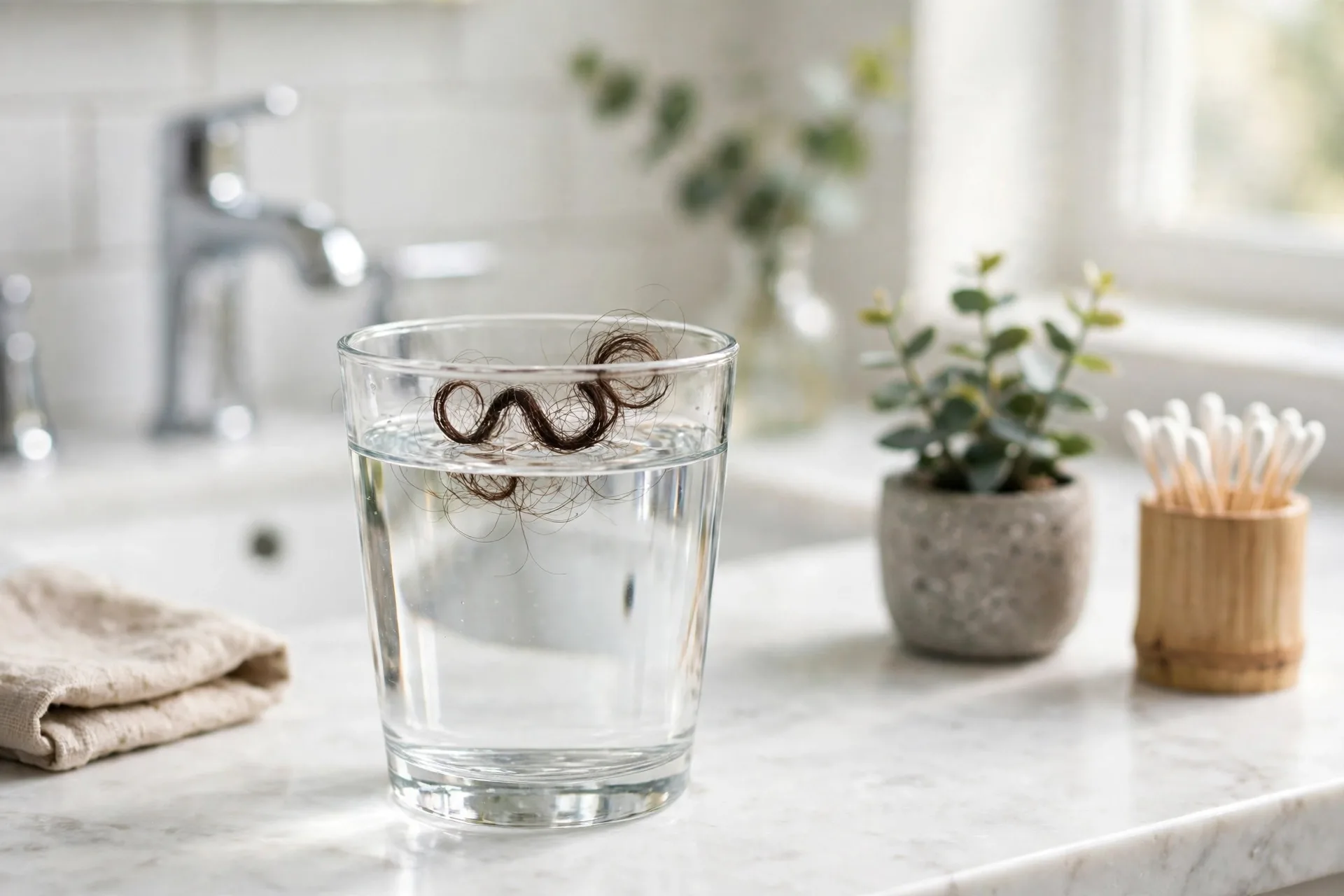
- Your porosity is how easily your hair absorbs and holds water, and the simplest way to check it is the float test: drop a clean strand in a glass of water and watch whether it floats, hovers, or sinks after two to four minutes.
- Most people have more than one pattern on their head, so go with the pattern that covers most of your hair, and pick products for your porosity first, because porosity decides whether moisture stays in or slips straight out.
Why Your Curl Type and Porosity Matter
Walk down any hair-care aisle and you will see bottles promising defined curls, frizz control, and bounce. None of those promises mean much until you know what your hair actually needs. A heavy butter that makes tight coils soft and shiny can leave loose waves flat and greasy in a single use. A light spray that gives waves a lift can vanish from high-porosity curls before you even leave the house.
That is why hair typing exists. It is not a beauty contest and it is not a label you have to wear forever. It is a short cut to better choices. When you know your pattern, you know how much hold and weight your hair can handle. When you know your porosity, you know whether your hair needs help absorbing moisture, help holding on to it, or a lighter touch so it does not get weighed down.
This guide is about finding those two answers. It is not a care routine, and it will not tell you to buy a shelf full of products. It gives you three simple tests you can do at home with a glass of water, a spray bottle, and your own fingers, plus a visual chart so you can match what you see in the mirror to a real type. Set aside about fifteen minutes, and do the tests on freshly washed hair with no styling products in it, because product residue changes everything these tests measure.
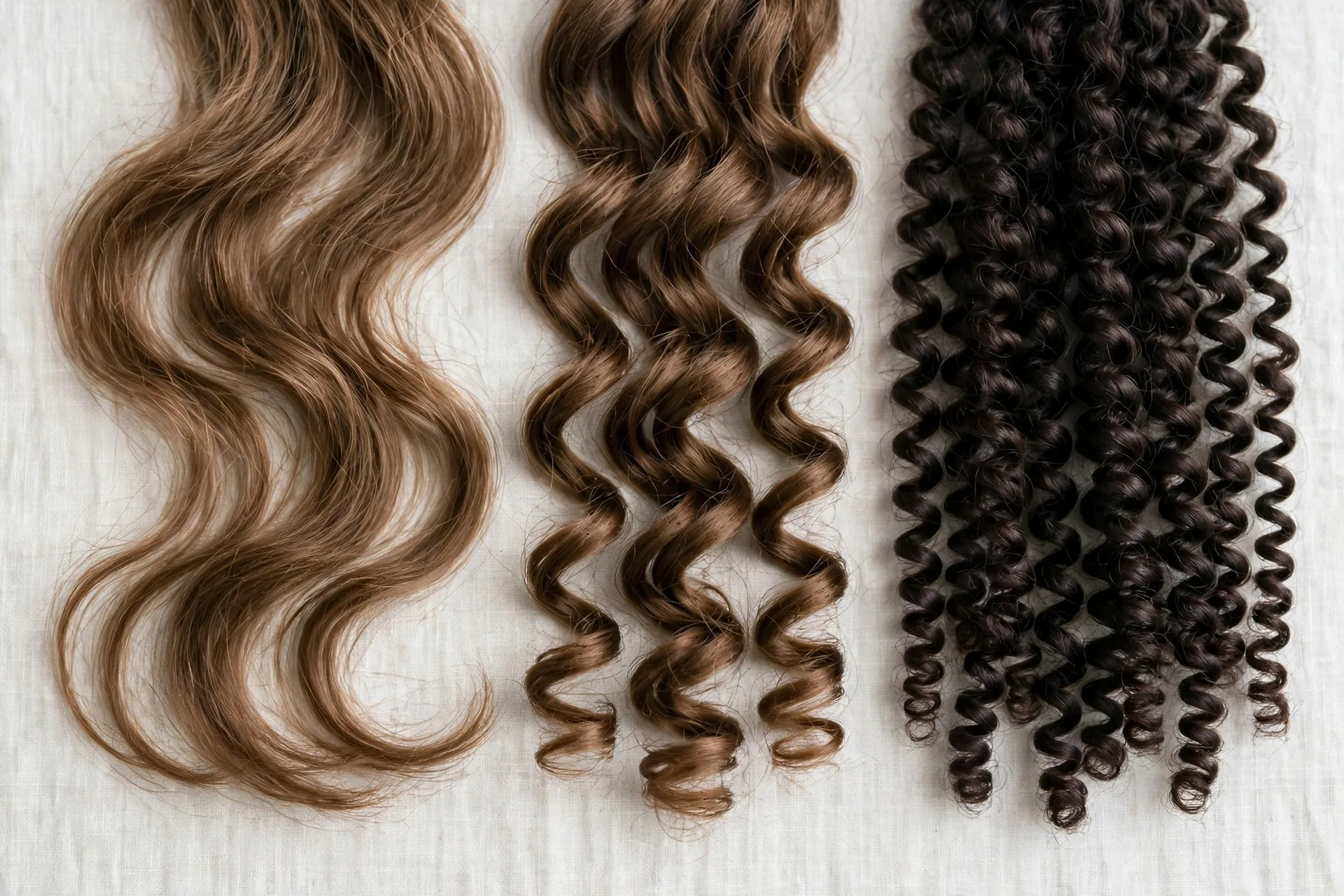
The Curl Pattern Chart: 2A to 4C
The most widely used hair typing system groups hair into four families, numbered 1 to 4, with letters A to C showing how tight the shape gets inside each family. Type 1 is straight hair, so if your hair has any bend at all, you start at type 2. Each step up the chart means a tighter shape, more volume, and usually more dryness, because the natural oils from your scalp have a harder time travelling down a winding strand.
Before you read the descriptions, look at your hair after it has air-dried with no product and no brushing. Brushing stretches curls out and hides the real shape. A quick photo in daylight helps too, because it is easier to compare a photo to a chart than to twist around in a mirror.
Type 2: Wavy Hair
2A hair has a gentle, loose S-shape that starts around mid-length. It is fine, easy to straighten, and it often looks almost straight on top with a soft bend at the ends. It gets weighed down fast, so heavy creams are usually too much for it.
2B hair has a clearer S-wave from the roots down, with a bit more texture and a tendency to frizz in humidity. It holds a wave well with a light mousse or a sea-salt spray, and it can look flat at the crown if products are too rich.
2C hair has strong, defined waves that border on curls, with thicker strands and more volume. It can frizz easily and it often needs a light gel or cream to keep the wave pattern together through the day.
Type 3: Curly Hair
3A hair forms large, loose curls about the width of a wine cork. The curls are shiny, springy, and easy to define with a cream or a light gel. They can drop into waves by the end of the day if the product is too light.
3B hair forms bouncy ringlets about the width of a marker pen. It has more volume than 3A and more frizz, and it usually needs a curl cream plus a gel to hold its shape.
3C hair forms tight, dense corkscrew curls about the width of a pencil. It has plenty of volume, it can shrink a lot when it dries, and it drinks up moisture fast, so richer creams and leave-in conditioners suit it well.
Type 4: Coily and Kinky Hair
4A hair forms small, springy coils about the width of a crochet needle, with a clear S-pattern when stretched. It holds moisture better than 4B and 4C, but it still needs regular conditioning and gentle handling.
4B hair has a sharp Z-shaped pattern with less visible curl definition and more shrinkage. It feels soft and cottony, tangles easily, and needs butters and creams to stay soft.
4C hair has the tightest coils, with a very dense zigzag pattern and the most shrinkage, sometimes up to 70 percent or more. It is the most fragile of all the types, so it needs the gentlest handling, plenty of moisture, and protective styles that keep the ends tucked away.
Use the chart as a starting point, not a verdict. If the front of your hair is 3A and the back is 3B, that is completely normal. Most heads carry two or even three patterns. Pick the one that covers the largest area, and treat the other sections a little differently if they need it.
How to Find Your Curl Pattern in 4 Steps
Finding your pattern takes one wash and a little patience. Do it on a day when you are not in a rush, and skip every styling product so you see what your hair does on its own.
- Wash with a gentle shampoo and conditioner. Use a sulfate-free shampoo if you have one, and rinse the conditioner out fully. Do not add leave-in, cream, gel, or oil afterwards.
- Let your hair air-dry without touching it. Do not brush it, comb it, or scrunch it while it dries. Brushing pulls the pattern apart, and scrunching adds shape that is not really yours. If you must detangle, use a wide-tooth comb only while the conditioner is still in.
- Look at the shape once it is fully dry. Check the roots, the mid-lengths, and the ends separately, because the pattern often changes along one strand. A single strand can be wavy at the root and curly at the tip.
- Compare it to the chart and check the width of one curl. Wrap one dry curl around a pen, a marker, or your finger. A curl that wraps loosely around a wine cork is 3A, one that fits a marker is 3B, one that fits a pencil is 3C, and a coil tighter than a pencil is type 4. For waves, look for the S-shape: a soft, stretched S is 2A, a clear S is 2B, and a deep, almost curly S is 2C.
Pro tip: take a photo of the back of your head too. The hair at the nape often has a different pattern from the hair at the front, and many people never see it. If the back is much tighter or looser, note it down, because it changes how you apply product there.
One more thing to keep in mind: your pattern can change over time. Hormones, pregnancy, heat damage, colour treatments, and even a big chop can all shift how your hair behaves. If a routine that worked for years suddenly stops working, re-check your pattern before you blame the products.
What Is Hair Porosity, Really?
Porosity is a simple idea with a big effect. Each hair strand is covered in tiny overlapping scales called the cuticle, a bit like shingles on a roof. When those scales lie flat and tight, water and products have a hard time getting in, and that is low porosity. When the scales are raised or damaged, water rushes in fast and escapes just as fast, and that is high porosity. Medium porosity sits in the middle: the scales are loose enough to let moisture in and tight enough to keep it there.
Porosity is mostly set by genetics, but it is not fixed. Colour, bleach, heat styling, sun, and rough brushing all lift the cuticle and push hair toward high porosity. That is why the ends of your hair, which are the oldest part, are often more porous than the roots. It is also why two people with the same curl pattern can need totally different products: one has low-porosity hair that repels a rich mask, and the other has high-porosity hair that soaks it up in seconds.
Knowing your porosity changes three practical things. It changes how you wash, because low-porosity hair needs warmth and time to open up, while high-porosity hair needs gentle handling to avoid more damage. It changes what you buy, because low-porosity hair likes light, water-based products, and high-porosity hair likes butters, oils, and proteins that seal the gaps. And it changes how often you deep condition, because high-porosity hair needs it far more often than low-porosity hair does.
Test 1: The Float Test
The float test is the best-known porosity test, and it only needs a glass of room-temperature water and a few clean strands of your own hair.
- Take three or four strands from different parts of your head. Use strands that fell out naturally, from your brush or your shower drain, not strands you pull out. Pick from the crown, the sides, and the ends if you can.
- Wash the strands with a drop of plain shampoo and let them dry. This step matters more than people think. Product build-up coats the strand and makes it float even when the hair underneath is porous.
- Fill a clear glass with room-temperature water and drop the strands in. Push them gently under the surface with a finger so they start fully wet, then leave the glass alone.
- Wait two to four minutes and check where the strands sit. Do not wait much longer than that, because even low-porosity hair will eventually sink once water works its way in.
How to read it: if the strands stay floating on top, your cuticle is tight and you likely have low porosity. If they hover in the middle of the glass, you likely have medium porosity. If they sink to the bottom quickly, water rushed into the strand, which points to high porosity.
The float test is a good starting point, but it is not perfect. Very fine hair can float because it is light, and a strand with heavy build-up can float even if it is porous. That is why the next two tests matter. If all three tests point the same way, you can trust the result. If they disagree, trust the strand test and the spray-bottle test over the float test, because they measure how your hair behaves in real life.
Test 2: The Strand Test (Slide Test)
The strand test is the fastest of the three, and you can do it right now without any tools at all. It tells you how smooth or rough your cuticle feels, which is a direct clue to your porosity.
- Take one clean, dry strand of hair. Hold it at the tip between the thumb and finger of one hand so it hangs straight.
- Slide the thumb and finger of your other hand up the strand, from tip toward root. Move slowly and pay attention to what you feel, not what you see.
- Notice how the strand feels under your fingers. Repeat it with a strand from a different part of your head, because the crown and the ends can feel very different.
How to read it: if the strand feels smooth and your fingers glide up easily, the cuticle lies flat, which points to low porosity. If you feel a slight roughness or a few tiny bumps, you likely have medium porosity. If the strand feels rough, bumpy, or catches on your fingers as you slide up, the cuticle is raised, which points to high porosity.
Pro tip: do this test on a strand you have not just conditioned, or the conditioner will coat the cuticle and make every strand feel smooth. Freshly washed, product-free hair gives the honest answer.
Test 3: The Spray-Bottle Test
The spray-bottle test shows you porosity in action, because it measures how fast your hair actually takes in water. All you need is a spray bottle filled with plain water and a mirror.
- Start with clean, dry hair and no products. Part a small section at the front so you can watch it closely.
- Mist the section once or twice with water. Use a fine mist, not a soaking stream, and watch the droplets for ten to twenty seconds.
- Watch what the water does. Does it sit on top, does it vanish, or does it soak in slowly?
How to read it: if the water beads up and sits on the surface of your hair, your cuticle is tight and you likely have low porosity. If the droplets sink in slowly over ten to twenty seconds, you likely have medium porosity. If the water disappears into the strand almost at once, your hair is soaking it up fast, which points to high porosity.
This test is worth doing on a wash day too. Low-porosity hair takes a long time to get fully wet in the shower, and it can take hours to dry. High-porosity hair gets soaking wet in seconds and dries fast, but it also frizzes fast once it is dry. If that sounds like your hair, the spray test has just confirmed it.

Reading Your Results: Low, Medium, and High Porosity
Put the three tests together and you will see a pattern. Here is what each level means in everyday terms, and what your hair is likely doing in the shower and on a humid day.
| Porosity | Float test | Strand test | Spray test | Everyday signs |
|---|---|---|---|---|
| Low | Strand floats | Smooth, fingers glide | Water beads on top | Slow to wet, slow to dry, products sit on top, easily weighed down |
| Medium | Strand hovers in the middle | Slight roughness | Water sinks in slowly | Wets and dries at a normal pace, holds styles well, few problems |
| High | Strand sinks fast | Rough, bumpy, catches | Water vanishes at once | Wets fast, dries fast, frizzes easily, tangles, colour fades quickly |
If your tests disagree, look at the everyday signs first. How long does your hair take to dry? Does it frizz the moment you step outside? Does colour wash out in two weeks? Those habits are porosity talking, and they are often more honest than a single glass of water.
What Your Porosity Means for Product Choice
Porosity is the first filter for every product decision. Get this right and even a basic routine works well. Get it wrong and the most expensive cream in the shop will sit on your hair doing nothing, or vanish into it without a trace.
Low Porosity: Keep It Light and Warm
Low-porosity hair needs help letting moisture in. Use light, water-based leave-in conditioners and thin creams rather than thick butters, and apply products to damp hair so the water already in the strand helps carry them in. Warmth is your friend: a warm towel over a deep-conditioning mask, or a few minutes under a shower cap while you finish your shower, gently lifts the cuticle so the treatment can get in. Clarify with a gentle clarifying shampoo every two to four weeks, because build-up sits on low-porosity hair and blocks everything else. Skip heavy oils as a first step, since they tend to coat the strand and make the build-up worse. A few drops of a light oil, such as argan or grapeseed, over a water-based cream is usually plenty.
Medium Porosity: The Easy Middle
Medium-porosity hair is the easiest to care for, because it absorbs moisture at a normal pace and holds on to it. A balanced routine works well: a moisturising shampoo and conditioner, a leave-in conditioner, and a cream or gel for hold. Deep condition once every one to two weeks to keep the cuticle healthy, and use protein treatments only now and then, about once a month, because too much protein can make balanced hair feel stiff. You can use a wider range of products than either of the other two types, so this is the group where trying new products is lowest risk.
High Porosity: Seal It In and Repair
High-porosity hair needs two things: moisture, and something to lock it in. Use rich creams and butters, and finish with an oil or a butter to seal the cuticle after your leave-in conditioner. This layering method, often called the LOC or LCO method (liquid, oil, cream or liquid, cream, oil), works well because each layer slows down the moisture loss from the one underneath. Protein treatments help too, because protein fills the small gaps in a raised cuticle, but use them in moderation, about once every two weeks, and always follow with a moisturising mask so the hair does not feel stiff. Wash with cool or lukewarm water rather than hot water, which lifts the cuticle further, and rinse with cool water at the end. Deep condition every week, and protect your hair from sun and chlorine, which both push porosity higher.
Matching Products to Your Curl Pattern
Once porosity is sorted, your curl pattern decides the weight and hold of the products you pick. The rule is simple: the looser the pattern, the lighter the product, and the tighter the pattern, the richer it can be.
Types 2A to 2C: Light and Airy
Wavy hair gets weighed down by almost everything, so keep products light. A volumising mousse or a light curl cream gives waves shape without flattening them. Apply from mid-length to ends and keep product off the roots, where it kills volume fastest. A light gel scrunched in while the hair is damp helps waves hold through the day. Heavy butters, thick masks used too often, and oils applied near the scalp are the usual reason wavy hair looks limp by lunchtime.
Types 3A to 3C: Creams and Gels
Curly hair needs more moisture than wavy hair, and it needs hold to keep the curls defined. A curl cream plus a gel, applied to soaking-wet hair, is the combination that works for most people in this group. Scrunch the gel in, let the hair dry without touching it, then scrunch out the crunch once it is fully dry to leave soft, defined curls. Leave-in conditioner is worth using every wash day, and a weekly deep-conditioning mask keeps frizz down between washes.
Types 4A to 4C: Rich and Protective
Coily hair needs the richest products of all, because the tight shape stops natural oils from travelling down the strand. Butters, thick creams, and oils are your main tools, and layering them, cream first and then oil or butter to seal, keeps the hair soft for days. Wash less often than looser types, detangle gently with fingers or a wide-tooth comb while the conditioner is in, and use protective styles such as twists or braids to keep the ends safe. A silk or satin pillowcase or bonnet at night stops the hair from drying out while you sleep.
5 Mistakes That Give You the Wrong Result
These are the errors that show up again and again when people type their hair, and each one is easy to avoid once you know it.
1. Testing hair full of product. Leave-in conditioner, gel, and oil all coat the strand and change how it floats, slides, and absorbs water. Always test on clean, product-free hair.
2. Brushing before you look. A brush pulls curls into waves and waves into straight hair. Air-dry without brushing, then look.
3. Typing wet hair. Wet hair always looks curlier than it really is, because water weighs it down and stretches the pattern. Wait until it is fully dry.
4. Doing the float test with dirty strands. Build-up makes strands float even when the hair is porous. Wash the test strands first, or the test tells you about the build-up, not the hair.
5. Expecting one single type. Almost nobody has one pattern all over their head. If the front is looser than the back, you have not done the test wrong. You have just found out that your hair needs a little custom treatment in different sections.
A Quick Starter Routine Once You Know Your Type
Now that you have your two answers, here is a simple wash-day routine you can shape to fit them. Wash with a gentle, sulfate-free shampoo, then apply conditioner and detangle with a wide-tooth comb while it is still in. Rinse, then apply a leave-in conditioner to soaking-wet hair. Next, add your styler: a mousse for waves, a cream and gel for curls, or a butter and cream for coils. Let your hair air-dry or diffuse on low heat, and do not touch it until it is completely dry. At night, protect it with a silk bonnet or a loose pineapple ponytail on top of your head, and refresh in the morning with a light mist of water rather than a full wash. That is the whole routine. The details change with your type, but the shape stays the same, and that is the point: once you know your pattern and your porosity, you stop guessing and start choosing.
If you want a full step-by-step routine for your type, read our curly hair care routine guide next, where each step is laid out wash day by wash day.
Frequently Asked Questions
Can I have more than one curl pattern?
Yes, and most people do. It is very common for the hair at the front to be looser than the hair at the back, or for the crown to be curlier than the underneath layers. Go with the pattern that covers most of your head, and adjust the products in the sections that behave differently. A little extra cream on the tighter sections is usually all it takes.
Can my porosity change over time?
Yes. Bleach, colour, heat styling, and sun exposure all lift the cuticle and raise porosity, which is why the ends of long hair are often more porous than the roots. The good news is that you can bring high porosity down a little with regular protein treatments, gentle handling, and less heat. Re-test every few months if you colour or heat-style your hair often.
Keep in mind that the float test alone can be misleading, especially if your hair has product build-up. Always check it against the strand test and the spray-bottle test, and trust what your hair does on a normal wash day.
Do I need expensive products for my hair type?
No. Knowing your type actually saves money, because you stop buying products that were never going to work for you. A low-porosity wavy head of hair needs a light leave-in and a mousse, not a shelf of heavy butters. A high-porosity coily head of hair needs a rich cream and a sealing oil, not a dozen light sprays. Start with the basics that match your type, use them for three or four wash days, and only add something new when you can see a clear gap in the results.