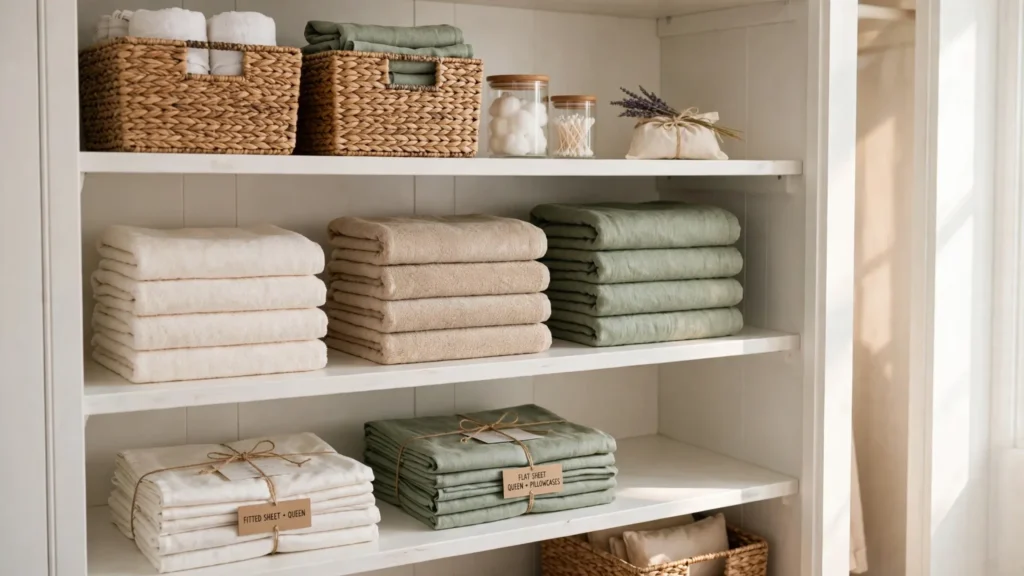

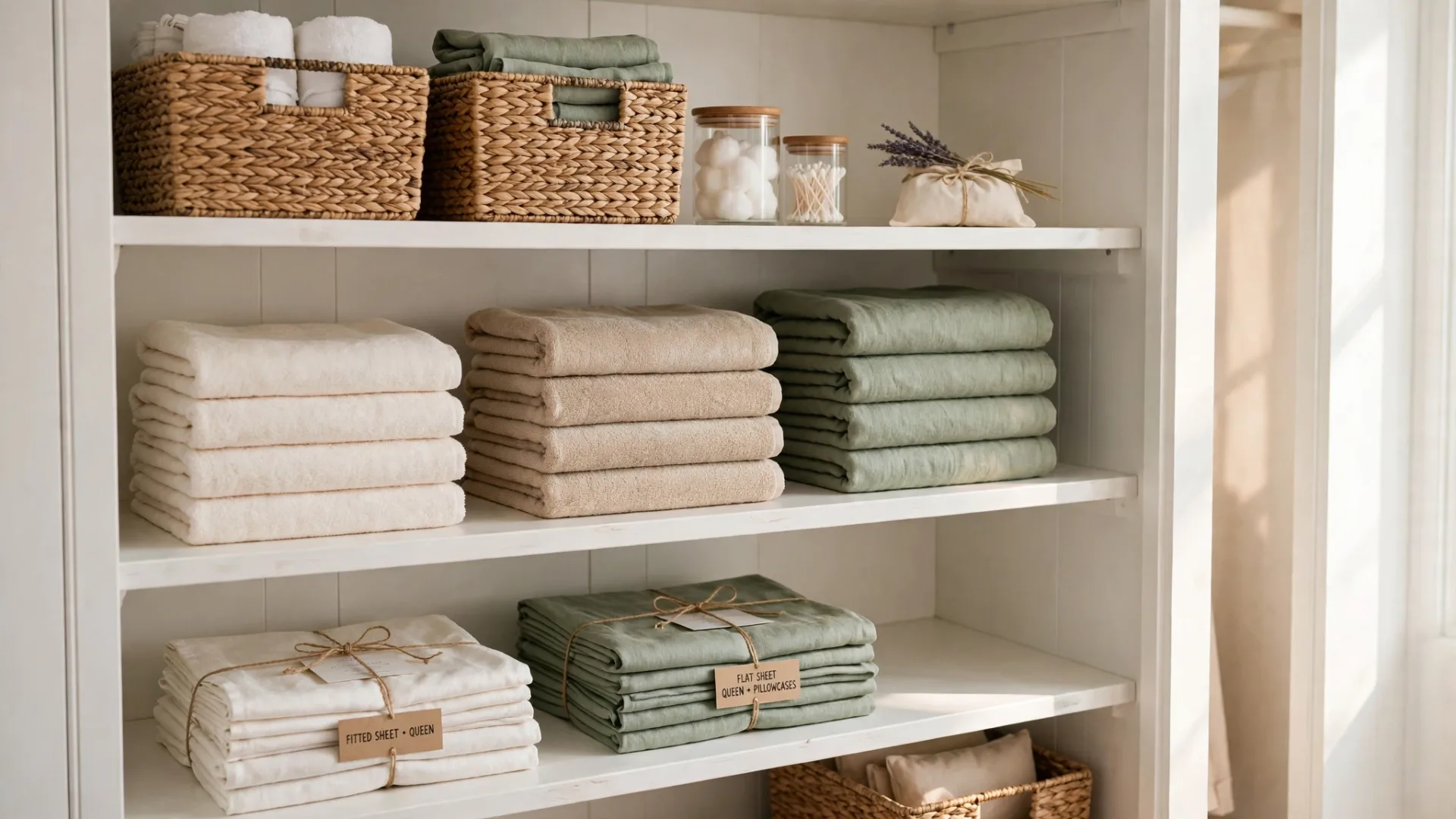
I still remember the afternoon I opened my linen closet and a beach towel fell on my head. Not a graceful little tumble — a full, damp-smelling avalanche of towels, a rogue fitted sheet, and one single pillowcase that didn’t match anything I owned. I stood there laughing, but honestly? It was the third time that month. That’s when I decided my linen closet needed more than a quick shove-and-shut.
Here’s the thing nobody tells you about linen closets: they’re small, so they hide their mess well. Unlike a pantry or a garage, nobody opens that door at a party. But you open it every single day — grabbing a towel, hunting for the right sheet set, digging past winter blankets for the summer quilt. A chaotic linen closet quietly steals five minutes of your day, every day. That’s over 30 hours a year spent wrestling with fabric.
I spent a full weekend fixing mine, and I’ve kept it that way for over a year now — which, for me, is basically a miracle. These are the linen closet organization ideas that actually worked, the mistakes I made along the way, and the little systems that keep everything neat long after the initial motivation fades.
1. Empty Everything First (Yes, Everything)
Every organizing guide says this, and every time I ignored it. For years I’d try to “tidy” my linen closet by refolding things in place, which is like trying to clean a fish tank without taking the fish out. It doesn’t work.
So this time I pulled every single item onto my bed. The bed became a mountain of towels, sheets, blankets, and — I am not exaggerating — fourteen pillowcases, of which maybe six had matching partners. Seeing it all at once was honestly embarrassing, but it was also the only way to be honest about what I actually owned.
As you sort, make three piles: keep, donate, and toss. Be ruthless with the toss pile. Towels that have gone stiff and scratchy despite your best efforts? They’re done. That duvet cover with the broken zipper you’ve been “meaning to fix” for two years? Done. Fitted sheets whose elastic gave up long ago? Also done. I donated two full garbage bags of linens to the local animal shelter — they happily take old towels and blankets for bedding.
A good rule of thumb I learned from a friend who runs a bed-and-breakfast: two to three full sets of sheets per bed, and two towel sets per person, is plenty. Everything beyond that is shelf clutter. My closet went from bursting to breathing after I applied that rule.
2. Sort by Category, Not by Room
My old system was “towels for the guest bathroom on this shelf, towels for the master on that shelf.” It sounds logical until your guest towels migrate into the master pile and everything blends into one fuzzy mess.
Grouping by category — all bath towels together, all sheet sets together, all blankets together — is much easier to maintain. When you come back from laundry day, you don’t have to think. Towels go in the towel zone. Sheets go in the sheet zone. Nobody has to remember which towel belongs to which bathroom.
I set up mine with three main zones: towels on the middle shelves (most-used, easiest to reach), bedding on the top shelves, and cleaning linens plus odd extras in bins on the bottom. A year later, the zones are still holding. When your family (or future you, half-awake at 6am) doesn’t have to think, the system maintains itself.
3. Fold Sheet Sets Into Their Pillowcase
This is the single trick that changed my linen closet the most. If you hate hunting for a matching flat sheet and pillowcase — and who doesn’t — fold the fitted sheet, the flat sheet, and the second pillowcase, then slide the whole stack inside the first pillowcase. You end up with one neat, self-contained bundle per bed set.
No more opening the closet and finding three fitted sheets for a queen bed and zero pillowcases. No more unfolding five things to figure out which set they belong to. Each bundle is labeled by size (I’ll get to labeling in a minute), and when it’s time to change the sheets, you grab one bundle and you’re done.
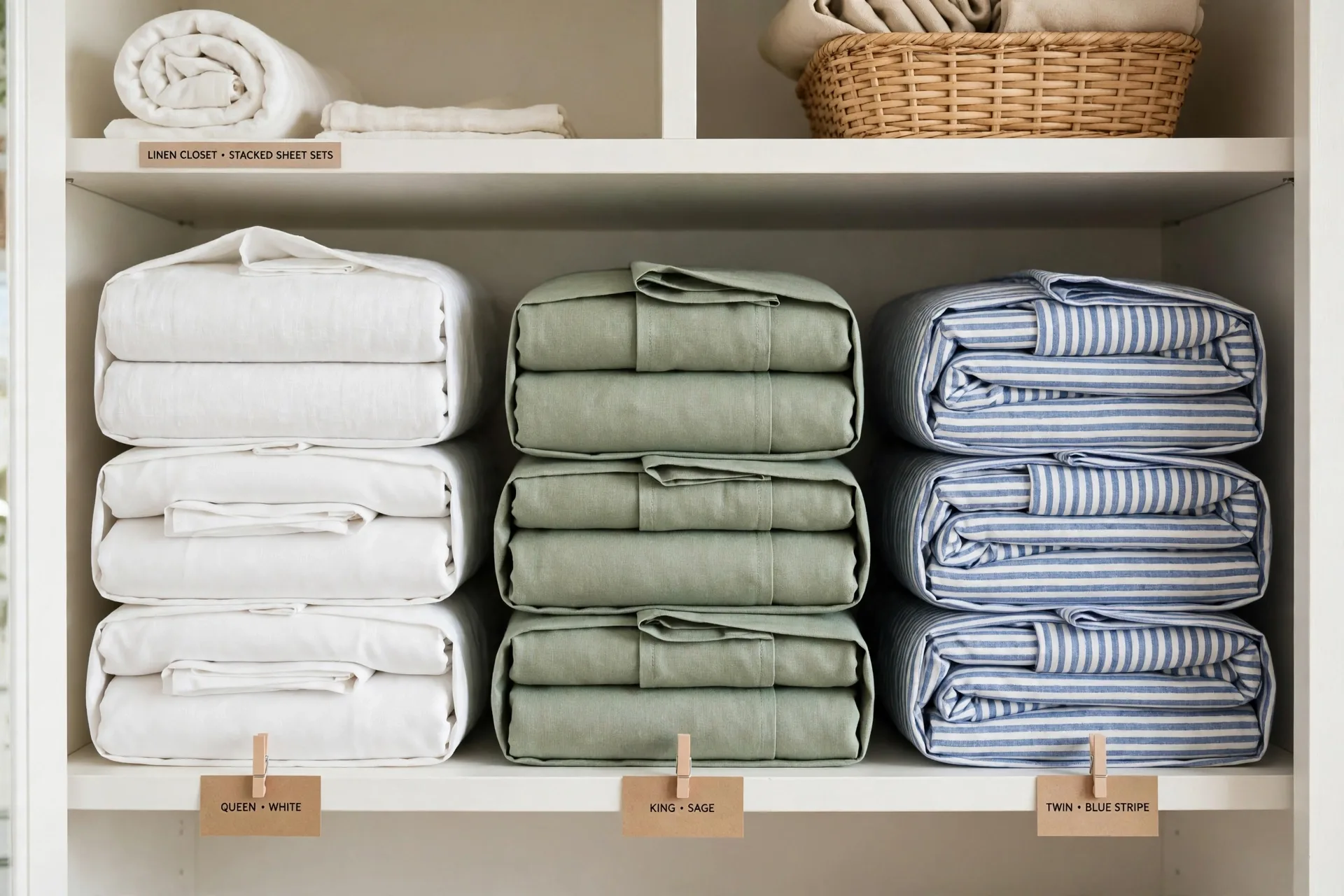
The bundles also stack beautifully — even rectangles that don’t topple. Before this, my sheets were an origami nightmare of mismatched folds. Now I fold each piece roughly the same size, tuck them in, and fold the pillowcase opening under. It takes about two minutes per set on laundry day, and it saves me that much time every single time I change the beds.
4. Fold Towels the Same Size Every Time
Towels stack neatly only if they’re folded to the same dimensions. This sounds fussy, but it’s the difference between a Pinterest-worthy shelf and a leaning tower of terrycloth. Pick one fold — I do thirds lengthwise, then halves — and use it for every towel. Same size folds, straight stacks.
I also keep my stacks short: four to five towels max. Taller stacks look impressive for a day and then collapse the first time someone pulls one from the middle. Short stacks stay put.
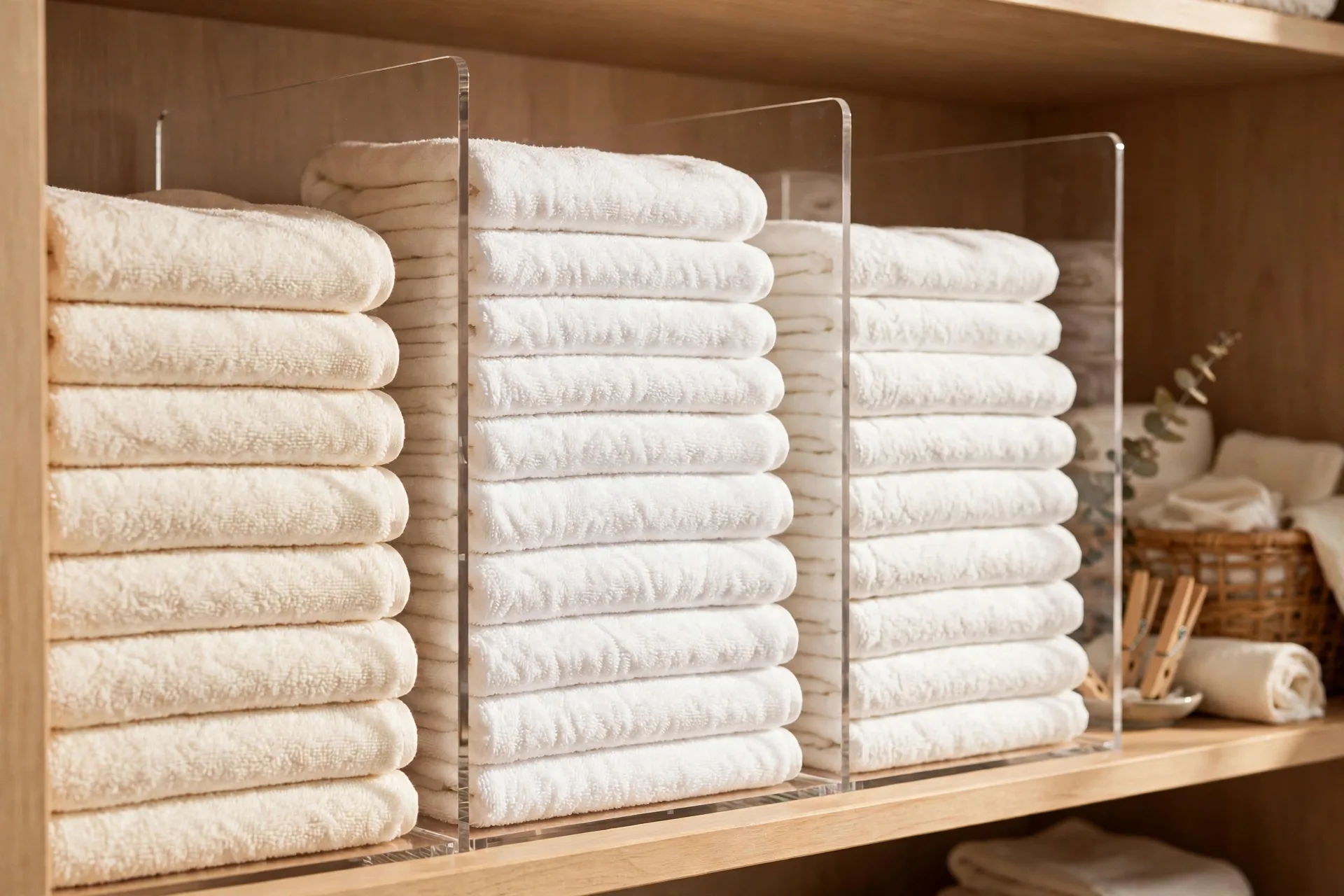
Here’s my favorite little upgrade: clear acrylic shelf dividers. They cost very little, slide onto the shelf in seconds, and they keep each towel stack standing on its own. Before I added them, pulling one towel would trigger a slow-motion domino effect across the whole shelf. Now each stack has its own lane. If you have kids who grab towels like they’re defusing a bomb, dividers are basically essential.
5. Corral the Small Stuff in Clear Bins
Washcloths, hand towels, guest toiletries, sewing kits, stain-remover sticks — the small stuff is what turns a tidy closet into chaos. Loose, they migrate everywhere. In a labeled clear bin, they stay put and you can see what’s inside without opening anything.
I use clear plastic bins from the dollar store — nothing fancy. One for washcloths, one for hand towels (rolled, spa-style, because it saves space and looks lovely), one for guest toiletries and travel extras. Being able to see through the sides means I never buy duplicates of things I already have, which was a genuine problem in my house.
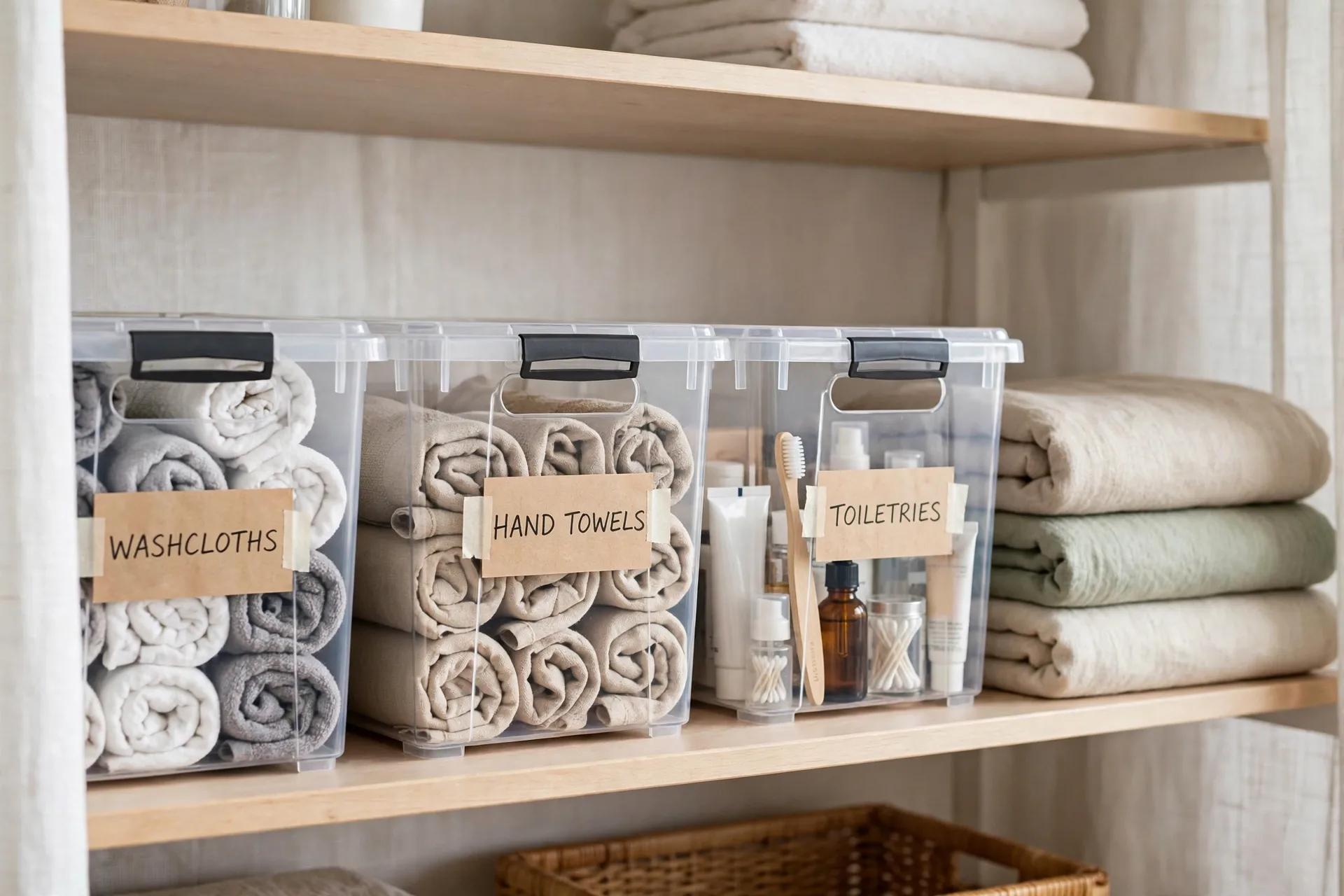
One tip: put the bins you reach for most at chest or eye level, and the rarely-touched ones higher up. I learned this the hard way after keeping the everyday hand towels on the top shelf for months and doing an awkward little stretch-dance every morning.
6. Label Everything (Future You Will Thank You)
I resisted labels for a long time because I thought they were overkill for one closet. I was wrong. Labels are the difference between a system that works for one week and a system that works for one year. They tell every other person in the house where things go — no explanations needed.
A simple label maker works, but honestly, kraft paper tags with a clothespin look nicer and cost almost nothing. I labeled shelf edges with things like “Queen Sheets,” “Bath Towels,” and “Guest Bedding.” Even my husband — who previously treated the linen closet like a suggestion box — now puts things back in the right spot. Mostly.
7. Make a Grab-and-Go Guest Basket
Overnight guests used to send me into a minor panic: scrambling for fresh towels, a spare toothbrush, clean pillowcases. Now I keep one woven basket on an easy-to-reach shelf with a full guest kit — two bath towels, two washcloths, a set of sheets, and a little pouch of travel-size toiletries.
When someone says they’re coming over, I hand them the basket and I’m done. After they leave, I wash everything, restock it, and put it back. It takes ten minutes and it makes me feel like the kind of person who has their life together. I highly recommend the feeling.
8. Shrink Bulky Blankets With Vacuum Bags
Winter comforters and guest quilts are space hogs. For nine months of the year, my heavy duvets were eating an entire shelf while I used none of them. Vacuum storage bags changed that — a king-size comforter shrinks to the size of a throw pillow.
Make sure everything is completely clean and dry before you seal it (damp fabric in a vacuum bag is a mildew disaster waiting to happen), then store the flat bags on the highest shelf or even under the bed. Label each bag so you know which one holds the guest quilt versus the winter duvet. When the season turns, unseal, fluff, and enjoy the shelf space back.
9. Keep Daily Towels at Chest Height
This sounds obvious, but check your closet right now: are your everyday towels where you can actually reach them without a step stool or a yoga pose? Mine weren’t. I’d buried the daily bath towels under the guest sheets, so every morning started with a mini excavation.
The rule is simple: things you touch every day live between your knees and your eyes. Seasonal stuff, backups, and the good tablecloths you use twice a year go high or low. Reorganizing by how often you actually use things — rather than by some abstract “system” — is what makes a closet feel effortless.
10. Don’t Waste the Door
The inside of the closet door is free real estate. An over-the-door organizer with clear pockets holds stain removers, extra soap, sewing supplies, lint rollers, and all those little things that otherwise get lost behind towel stacks. It adds zero bulk to your shelves and keeps the fiddly essentials visible.
I use the door pockets for things I grab on the way out of the laundry routine — the stain stick, the measuring cup for detergent pods, spare dryer sheets. It keeps the shelves clear for the big stuff and stops me from buying a third stain remover because I couldn’t find the first two.
11. Keep It Smelling Fresh
A linen closet should smell like clean fabric, not like a damp basement. The biggest freshness killer is storing anything even slightly damp — always make sure linens are bone dry before they go on the shelf. I also wipe down my shelves twice a year; you’d be surprised how much dust settles between folded stacks.
For scent, I skip the heavy plug-in air fresheners and use lavender sachets tucked between sheet bundles, plus a cedar block on the top shelf. Lavender keeps things smelling like a boutique hotel, and cedar helps discourage moths from making a meal of your wool blankets. Cheap, natural, and it genuinely works.
Mistakes I Made (So You Don’t Have To)
Let me save you my learning curve. First: I bought a bunch of matching baskets before decluttering, which meant I organized my clutter beautifully and still had too much stuff. Declutter first, buy containers second. Second: I overfilled every shelf on day one. Leave some breathing room — a closet packed to 100% looks great in a photo and lasts about a week in real life. Aim for 80% full at most.
Third, and this is the big one: I skipped the maintenance. A linen closet isn’t a one-and-done project. Every few months, I do a quick 20-minute reset — refold anything that’s gone lumpy, toss the washcloth that’s more hole than cloth, check whether I actually need four sets of twin sheets for a house with one twin bed. That little habit is the real secret. No system survives without a tiny bit of upkeep.
Final Thoughts
My linen closet isn’t a magazine spread, and honestly it doesn’t need to be. What it is now is a place where I can find a queen sheet set in ten seconds, where towels come out of their stack without a landslide, and where opening the door doesn’t make me wince. That’s the real win.
Start with the purge — everything out, honest piles, donate the extras. Then pick just two or three of these ideas: the pillowcase bundle trick and the shelf dividers alone will transform your closet in an afternoon. The rest can come later. Small changes, done consistently, beat a perfect system that falls apart in a month. Happy organizing.