

The first time I put vitamin C serum on my face, I did everything wrong.
It was a Saturday morning, I had just bought a 20% L-ascorbic acid serum because someone on the internet said it would fade my dark spots, and I squeezed a full dropper onto damp, freshly exfoliated skin. Within thirty seconds my cheeks were on fire. By the afternoon they were red, tight, and flaking. I threw the bottle in a drawer and declared vitamin C “not for me” for a solid year.
That was a mistake, because vitamin C was never the problem. My layering was. Once I learned the right order, the right pairings, and — this was the big one — how to introduce it slowly, my skin finally got that bright, even look I had been chasing, with zero burning.
If vitamin C has ever stung you, tingled uncomfortably, or left your face looking angrier than before, this guide is for you. Here is exactly how to layer vitamin C serum without irritation, based on what actually worked for me after a lot of trial and error.
Why Vitamin C Stings in the First Place
Before we fix the layering, it helps to know what causes the burn. Vitamin C in its pure form, L-ascorbic acid, is an acid — literally. Most serums sit at a pH between 2.5 and 3.5, which is well below your skin’s natural pH of around 5.5. That low pH is what lets the vitamin C penetrate and do its job, but it is also what makes sensitive or compromised skin protest.
Concentration matters too. A 5% or 10% serum feels like a gentle tingle to most people. A 20% serum on skin that has never seen vitamin C before can feel like you splashed hot sauce on your face. Add a damaged moisture barrier, a recent exfoliation session, or layering it right on top of retinol, and you have a recipe for a very red evening.
The good news: mild tingling for the first minute or two is completely normal and usually fades as your skin adapts. Real warning signs are different — burning that does not fade, hives, swelling, or peeling that lasts for days. That means you need to stop and reassess, not push through.

The 4 Golden Rules of Layering Vitamin C
Everything below comes back to four rules. Get these right and almost every irritation problem disappears.
Rule 1: Vitamin C Belongs in Your Morning Routine
Vitamin C is an antioxidant, and its superpower is neutralizing the free radicals your skin meets during the day — UV rays, pollution, blue light. Applying it in the morning means it is sitting on your skin exactly when those aggressors show up.
There is a bonus benefit too: vitamin C layered under sunscreen actually boosts your sunscreen’s effectiveness. The sunscreen blocks the UV rays, and the vitamin C mops up the damage from whatever slips through. They are a genuine dream team. Just do not treat vitamin C as sunscreen by itself — it filters nothing. SPF is still non-negotiable.
You can use vitamin C at night if your morning is already crowded with other actives, but morning is the slot where it shines brightest.
Rule 2: Apply It to Clean, Dry Skin — Thinnest to Thickest
The classic layering order still applies: thinnest product first, thickest last. Vitamin C serum is water-light, so it goes right after cleansing and toning, before anything heavier.
One detail people get wrong: apply it to dry skin, not damp. Damp skin absorbs products faster and deeper, which sounds good until you remember that this serum is a low-pH acid. On damp skin it penetrates more aggressively and stings more. I pat my face dry with a clean towel and wait about a minute before the serum goes on. That single habit cut my tingling in half.
Rule 3: Start Low, Go Slow
If you are new to vitamin C, do not start at 20%. A 5% to 10% concentration delivers visible brightening with far less drama. Products like the CeraVe Skin Renewing Vitamin C Serum (10% with ceramides built in) or the La Roche-Posay 10% Pure Vitamin C were basically designed for people whose skin throws a tantrum.
Frequency matters as much as strength. Use it every other morning for the first two weeks. If your skin stays calm, move to daily. Only think about climbing to 15% or 20% — something like Paula’s Choice C15 or the famous SkinCeuticals C E Ferulic — after your skin has clearly adjusted.
And patch test. I know, everyone says it, nobody does it. A dab on your jawline for 24 hours is a small price to pay for not finding out you are reactive across your entire face.
Rule 4: Give Each Layer a Minute to Breathe
Vitamin C needs about 60 to 90 seconds to absorb before you pile moisturizer on top. Trapping a wet acid under a heavy cream increases how much of it pushes into your skin at once, which increases stinging. Brush your teeth, pick your outfit, then come back and continue. Your face will thank you.
What Not to Mix With Vitamin C (in the Same Routine)
This is where most people sabotage themselves. Vitamin C plays well with many ingredients, but a few combinations are asking for trouble.
Retinol: Keep It at Night
Vitamin C and retinol in the same routine is the number one layering mistake I see. Both are powerful actives, and stacking them multiplies irritation risk without multiplying benefits. The dermatologist-approved protocol is dead simple: vitamin C in the morning, retinol at night. You get both ingredients’ full benefits and your barrier stays intact.
AHAs, BHAs, and Exfoliating Toners: Separate Them
Glycolic acid, salicylic acid, lactic acid — these chemical exfoliants temporarily change your skin’s pH and strip away the protective top layer. Slapping vitamin C on right after is like pouring lemon juice on a fresh paper cut. Use your acids at night and your vitamin C in the morning. If you insist on using both in the morning, wait a full 15 to 20 minutes between them, though honestly the separate-routines approach is easier and safer.
Benzoyl Peroxide: Just Don’t
Benzoyl peroxide can oxidize vitamin C on contact, which means both products stop working properly and your skin gets irritated for nothing. If you use benzoyl peroxide for breakouts, keep it in your evening routine, far away from your morning vitamin C.
Niacinamide: Actually Fine (Despite the Old Rumor)
You may have read that vitamin C and niacinamide cancel each other out or form something irritating. That warning comes from decades-old lab chemistry involving high heat — conditions that do not exist on your face. Modern formulations mix the two routinely, and studies show they layer just fine. If it makes you feel better, you can still split them — vitamin C in the morning, niacinamide at night — but you are not required to.
The Buffer Method: My Sensitive-Skin Secret Weapon
If your skin is on the reactive side, here is the trick that saved my relationship with vitamin C: apply a light hydrating layer first.
A thin layer of hyaluronic acid serum or a simple, fragrance-free moisturizer before the vitamin C creates a small cushion. The vitamin C still gets through — you will still see brightening over time — but the buffer takes the edge off the acidity. It is like drinking coffee with milk instead of black when your stomach is sensitive.
I did this for the first month with every new vitamin C product I tried, then dropped the buffer once my skin adapted. Think of it as training wheels, not a permanent crutch.
My Exact Step-by-Step Morning Routine
Here is the full routine I use now, in order. It takes about five minutes.
- Gentle cleanser. Nothing foamy or stripping — just a mild gel or cream cleanser to remove overnight oil. On mornings when my skin feels fine, I sometimes skip this and rinse with lukewarm water instead.
- Toner (optional). If I use one, it is a simple hydrating toner with no acids. Pat it in, then wait until my face is fully dry.
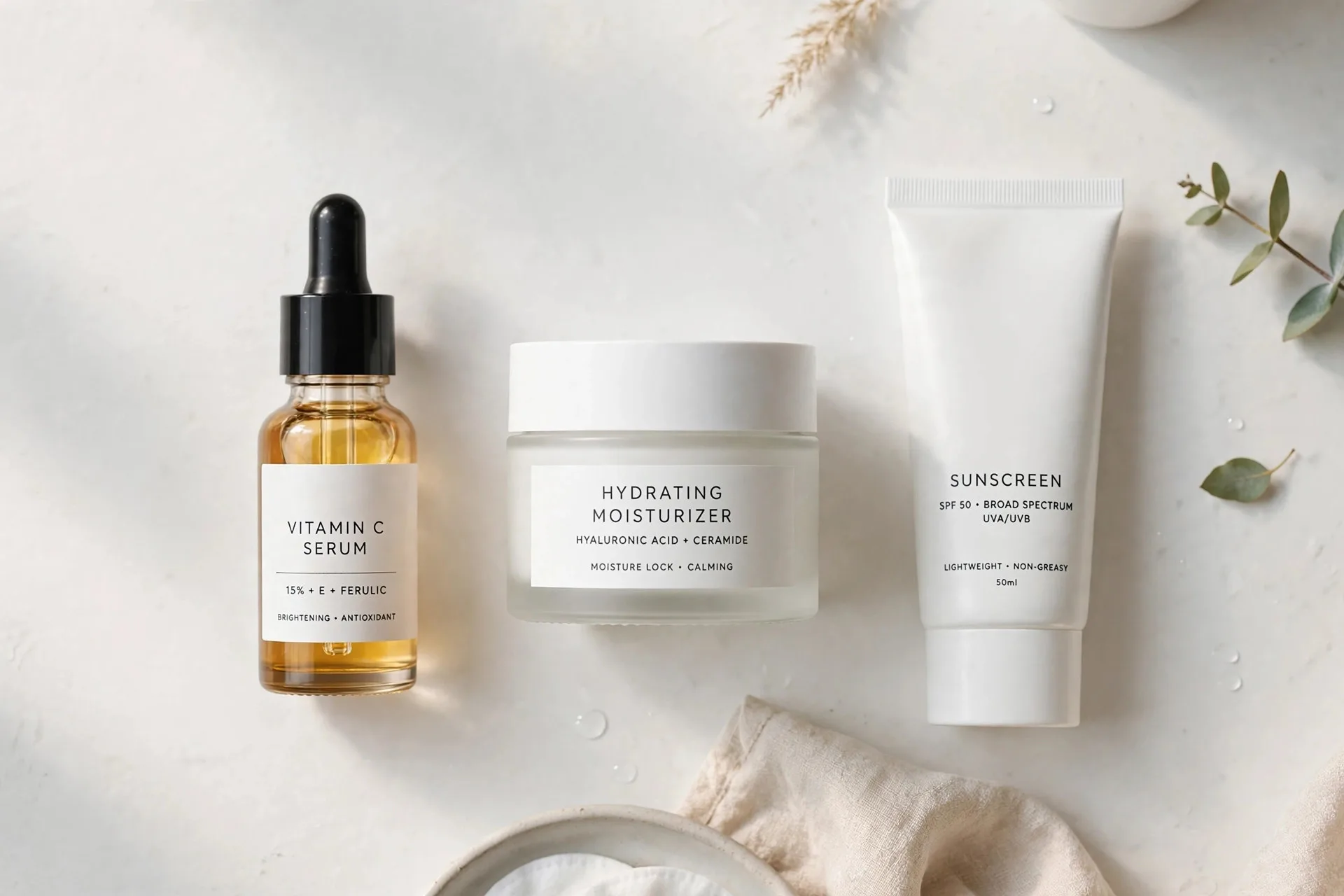
- Vitamin C serum. Three to five drops, pressed into dry skin with my fingertips — forehead, cheeks, chin, nose. I never rub it in aggressively. Then I wait about a minute.
- Hydrating serum (optional). On dry winter mornings I add a hyaluronic acid serum here. Skip it in summer when my skin is already hydrated.
- Moisturizer. A lightweight, fragrance-free moisturizer to seal everything in and support the barrier. This step does more anti-irritation work than people realize.
- Sunscreen. Broad-spectrum SPF 30 or higher, always. The EltaMD UV Clear is my go-to because it plays nicely under makeup, but any sunscreen you will actually wear daily is the right one.
That is the whole thing. Six steps, and the vitamin C sits exactly where it should: early, on dry skin, with a cushion of hydration behind it and sunscreen ahead of it.
7 Mistakes That Cause the Burn
Quick checklist — if vitamin C is irritating you, one of these is almost certainly the culprit.
- Starting at 20%. Begin at 10% or below. Your future face will thank you.
- Applying on damp skin. Dry skin first, always. Damp skin supercharges absorption and stinging.
- Using a full dropper. Three to five drops covers the whole face. More product does not mean more results — it means more irritation.
- Layering over a broken barrier. If your skin is already red, flaking, or stinging from over-exfoliation, fix the barrier first. Vitamin C on damaged skin is a bad time.
- Mixing with retinol or acids in the same routine. Mornings are for vitamin C; nights are for everything else.
- Skipping moisturizer. Moisturizer locks the vitamin C in and keeps your barrier happy. Never skip it, especially as a beginner.
- Using an oxidized bottle. If your serum has turned dark amber or brown and smells like hot metal, it has oxidized. It will irritate your skin and do nothing for your glow. More on this below.
How to Tell If Your Serum Has Gone Bad
Vitamin C is famously unstable. Light, heat, and air break it down, and an oxidized serum is both useless and irritating — the worst combination. A fresh L-ascorbic acid serum is clear or very pale straw-colored. As it oxidizes it turns yellow, then amber, then a dark tea color. A slight golden tint is fine; dark amber means it is done.
Smell is the other tell. Fresh vitamin C has a faint metallic or slightly sour scent. When it goes bad, that smell gets sharp and unpleasant — people describe it as hot dog water, which is disturbingly accurate.
Protect your bottle: keep it in a cool, dark place (not the steamy bathroom), close the cap tightly every time, and do not buy the jumbo bottle if you cannot finish it in about three months. Opaque, airtight packaging lasts far longer than a clear dropper bottle left on a sunny shelf. Some people keep theirs in the fridge, which works fine too.
Quick FAQs
Can I use vitamin C serum every day?
Yes, once your skin adjusts. Start every other morning for two weeks, then go daily. Daily morning use is what dermatologists recommend for the best results.
Does vitamin C replace sunscreen?
No. Vitamin C neutralizes free radicals but does not block UV rays. Always finish with SPF 30 or higher. The two together are stronger than either alone.
Is tingling normal, or is something wrong?
Mild tingling for a minute or two is normal, especially when you are new to it. Burning, itching, hives, or redness that lasts for hours is not — scale back frequency or switch to a gentler derivative like sodium ascorbyl phosphate.
Can vitamin C cause purging?
True purging — a temporary flare of clogged pores — is mostly associated with exfoliating acids and retinoids, not vitamin C. If you break out after starting vitamin C, it is more likely irritation or a reaction to something else in the formula. Give it two weeks; if it does not settle, the formula is not for you.
What is the best vitamin C for sensitive skin?
Look for gentler derivatives instead of pure L-ascorbic acid: sodium ascorbyl phosphate (SAP), magnesium ascorbyl phosphate (MAP), or tetrahexyldecyl ascorbate. They work at a skin-friendlier pH and are far less likely to sting.
Final Thoughts
Vitamin C went from the product that burned my face to the one I would rescue first in a fire — but only because I stopped fighting my skin and started working with it. Lower strength, dry skin, morning slot, a minute between layers, and sunscreen on top. That is genuinely the whole secret.
If you take one thing from this article, let it be this: irritation is information, not failure. Your skin is telling you the strength is too high, the order is wrong, or the timing is off. Listen to it, adjust one variable at a time, and give each change a week or two to show you what it does. The glow is worth the patience — mine took about six weeks to show up, and it has not left since.