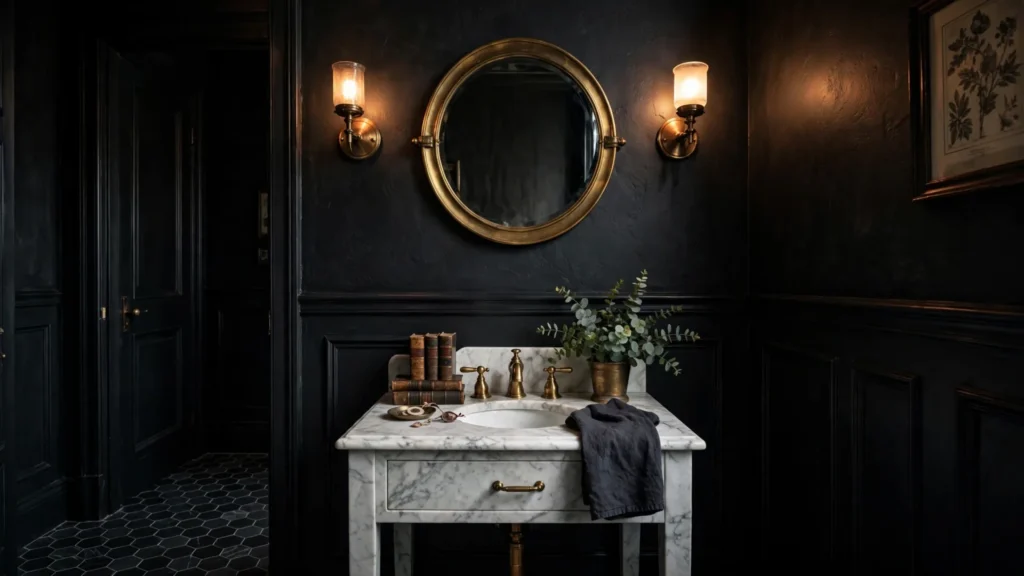

The first time I walked into a moody powder room, I actually gasped. It was at my friend Maya’s dinner party — her tiny half bath had deep green walls, a brass mirror that caught the light, and this incredible smell of cedar and soap. I must have stood in there a full minute just looking around, which is a weird thing to do in someone else’s bathroom, but I couldn’t help it.
Meanwhile, my own powder room was the saddest room in my house: beige walls, a builder-grade mirror glued to the wall, and a light fixture that made everyone look slightly ill. It took me three repaints in one year to figure out the moody look, including one disaster where I went full matte black and the room felt like the inside of a shoebox. But once I cracked the formula, my little powder room became the room guests compliment most. Here is everything I learned, so you can skip the shoebox phase.
Ground rules I wish someone had told me first
Moody is a feeling, not a paint color. The goal is “dramatic and cozy,” not “basement at midnight.” Every moody bathroom that actually works follows a few simple rules.
First, dark needs light to play against. Warm bulbs, a glowing sconce, a mirror that bounces light around — without these, dark walls just look flat. I learned this the hard way: my first attempt used the existing overhead fluorescent-style light, and the black walls looked dead.
Second, mix your textures. A room painted one flat color in one finish will always look cheaper than the same room with a mix of plaster, wood, brass, stone, and fabric. Texture is what makes dark feel rich instead of heavy.
Third, warm undertones are your friend. Paints with warm undertones (think charcoal with a brown base, or olive-green) look inviting under artificial light. Cool blue-blacks can go icy in a windowless powder room. This was my second repaint mistake, fixed by switching to Benjamin Moore’s “Wrought Iron,” which reads as a soft warm black.
Finally, the small size of a half bath is actually your superpower. You can afford the expensive wallpaper, the statement faucet, the splurge mirror — because you only need a few square feet of it. This is the one room in the house where going bold costs the least.
Moody wall ideas that set the tone
1. Charcoal walls with aged brass details
This is the classic, and it works because of the contrast. Deep charcoal on the walls, then warm aged brass everywhere your eye lands: the faucet, the mirror frame, the sconce. Keep the countertop light — white marble or a pale stone — so the room has somewhere for the eye to rest.
My trick: paint a sample board, not just a wall patch. I taped a big piece of poster board painted with two coats of the color and leaned it against the wall for three days, checking it morning, noon, and night under the actual bathroom light. Bathroom lighting changes everything.
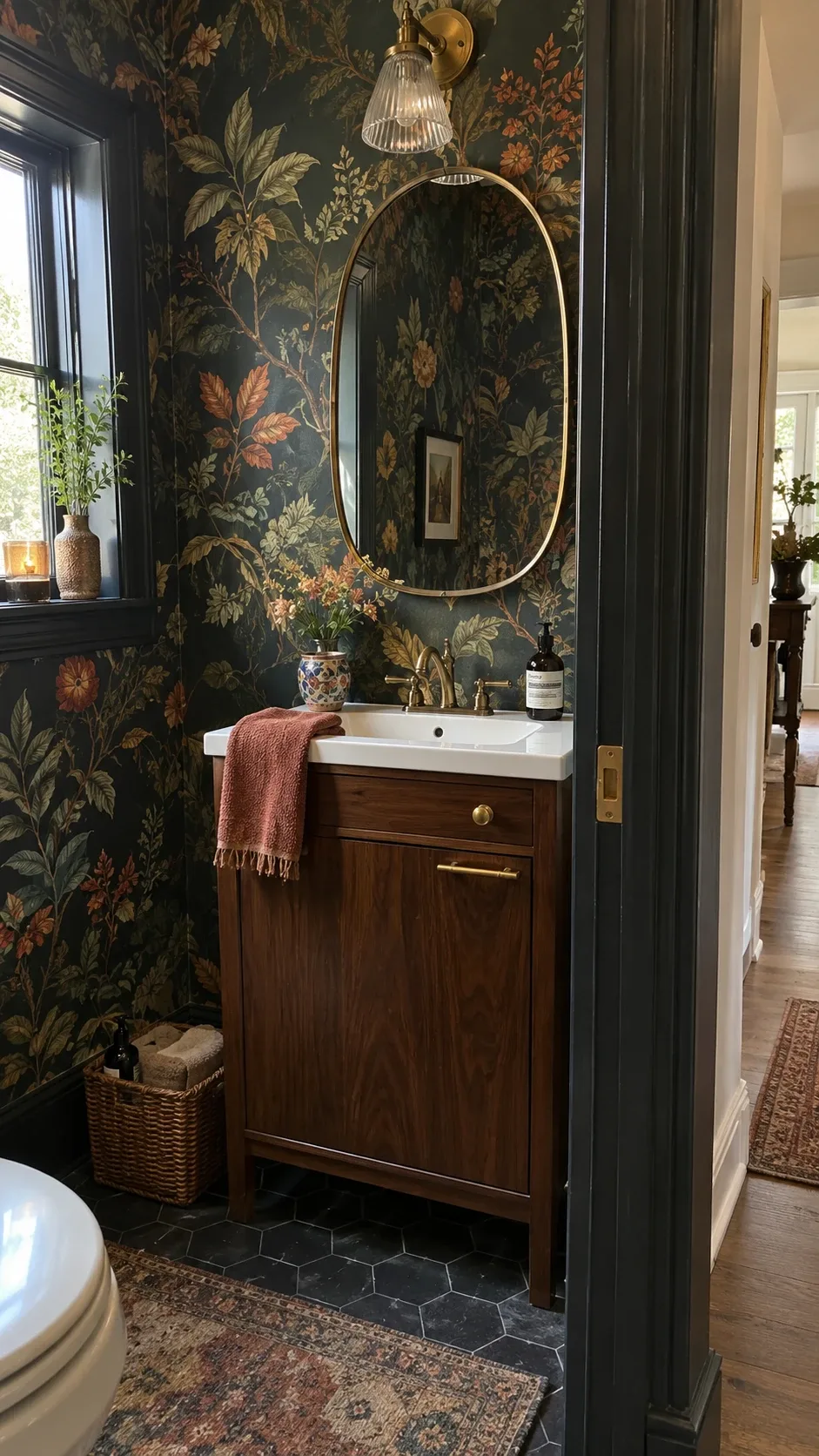
2. Moody botanical wallpaper above dark wainscoting
If you want drama without a full paint commitment, this combo is magic. A dark botanical wallpaper (deep greens, charcoals, muted plums) on the upper wall, with painted wainscoting below in a matching dark shade. The wainscoting is practical too — the lower half of a powder room wall takes the most abuse, and painted wood is far easier to wipe down and touch up than wallpaper.
Use a moisture-resistant wallpaper and seal the edges carefully around the toilet and sink. I used a peel-and-stick option from a small Etsy shop in my rental years ago, and it survived three years of steamy showers from the adjacent full bath without peeling.
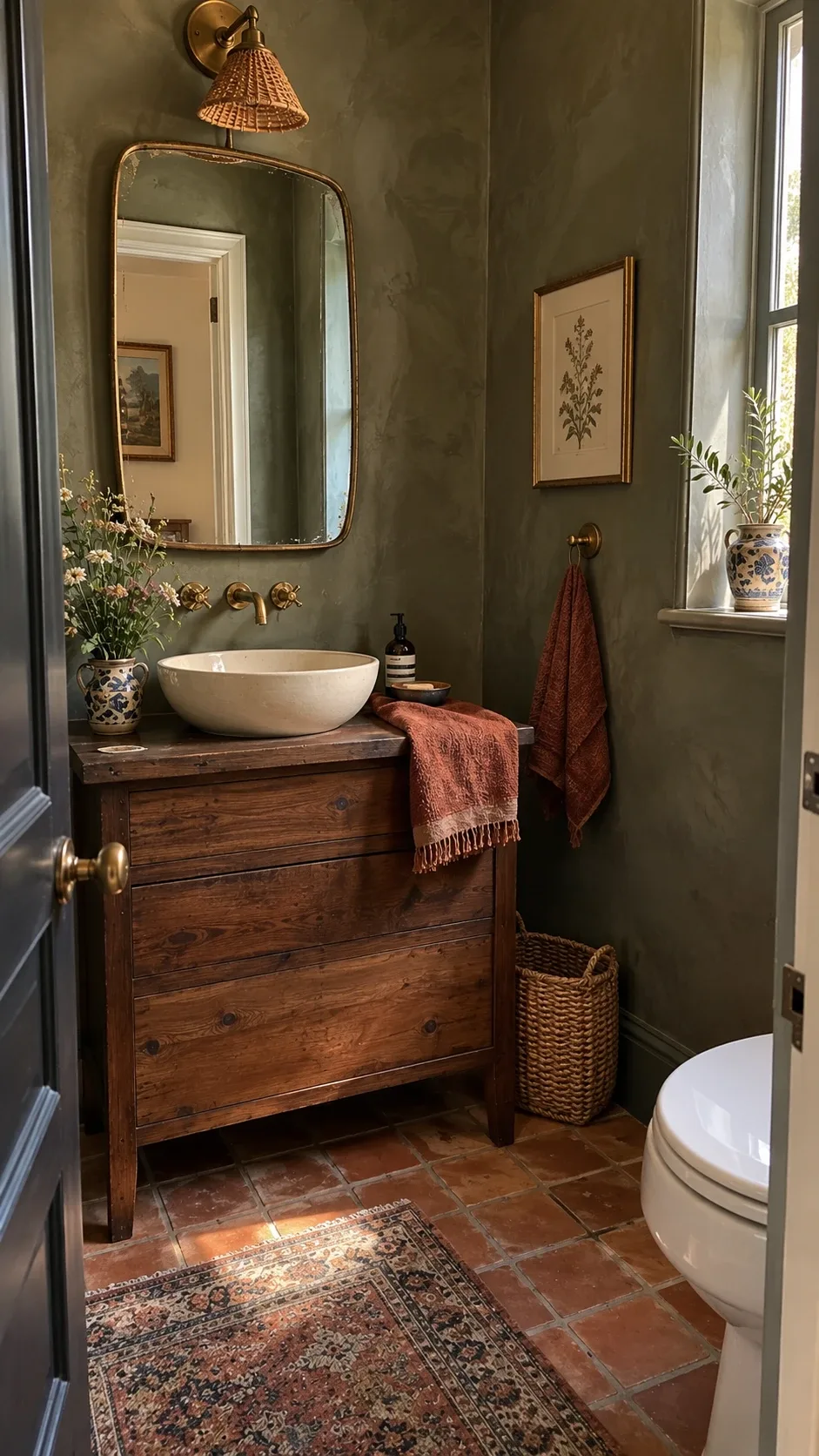
3. Hand-applied plaster in smoky olive-gray
Plaster is the secret weapon of moody rooms. Its slightly uneven surface catches light differently across the wall, so even a single color looks alive. A smoky olive-gray pairs beautifully with walnut wood, aged brass, and cream ceramics — it has this old-world feel that regular paint can’t quite fake.
You don’t need a professional. I used a trowel-on plaster finish from a box store, applied in thin layers with random trowel strokes, and sealed it with a matte bathroom-safe sealer. It took a weekend and looked like something from a boutique hotel. The key is subtle variation — go easy, because heavy texture in a tiny room can look messy fast.
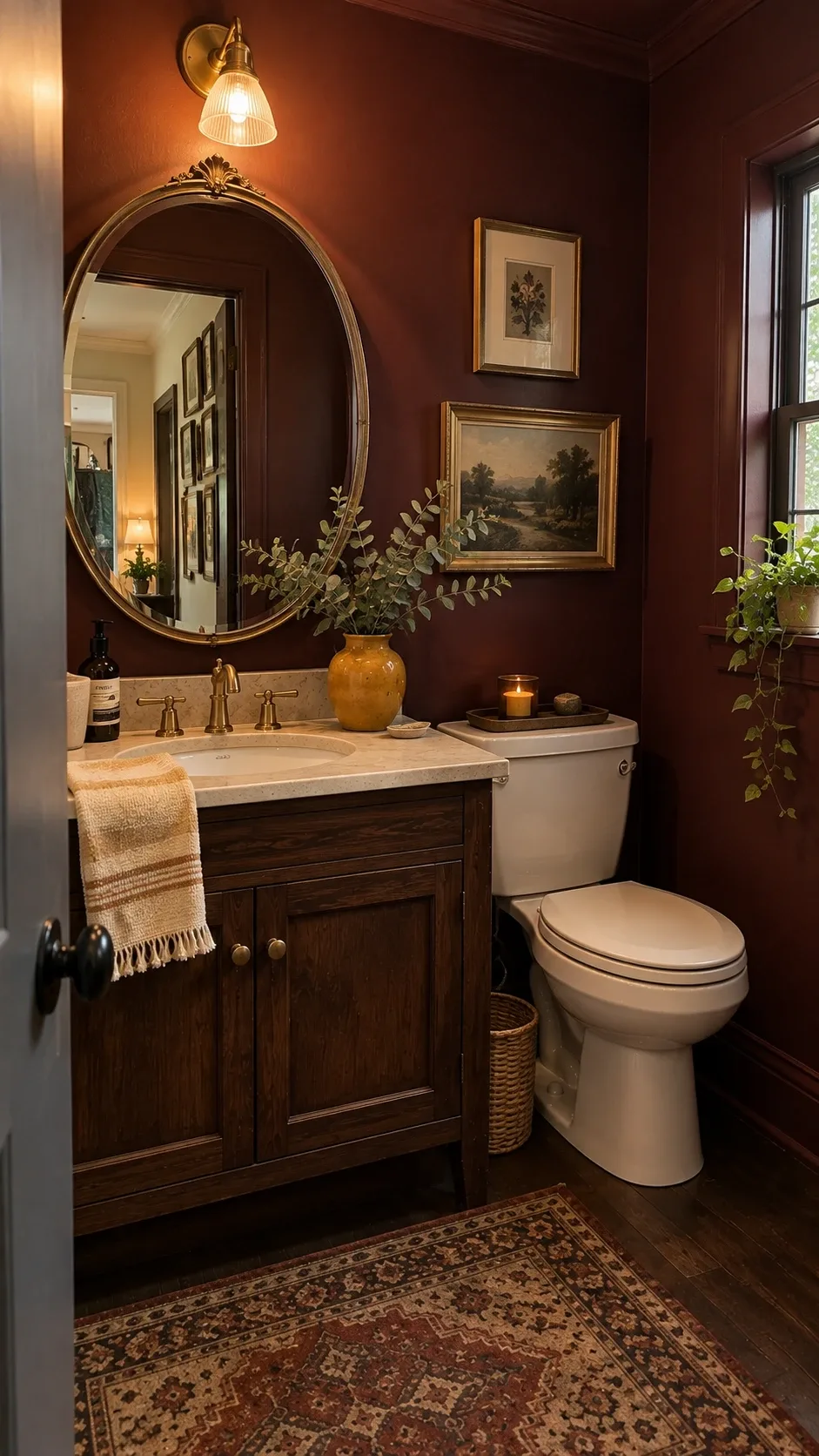
4. Muted burgundy walls with antique-inspired fixtures
Burgundy is the dark color nobody expects, and that’s exactly why it works. It’s warmer and more surprising than black, and it plays beautifully with antique brass, dark wood, and vintage mirrors. The catch: pick a muted, brown-based burgundy — an oxblood or wine — not a bright cherry red, which will dominate the small room and feel loud instead of moody.
Test it under your bathroom’s actual lighting before committing. My burgundy sample looked perfect in daylight and slightly purple under my old cool-white bulbs; swapping to 2700K warm bulbs fixed it completely. Light bulbs are the cheapest design tool you own.
5. Full color drenching — walls, trim, and ceiling
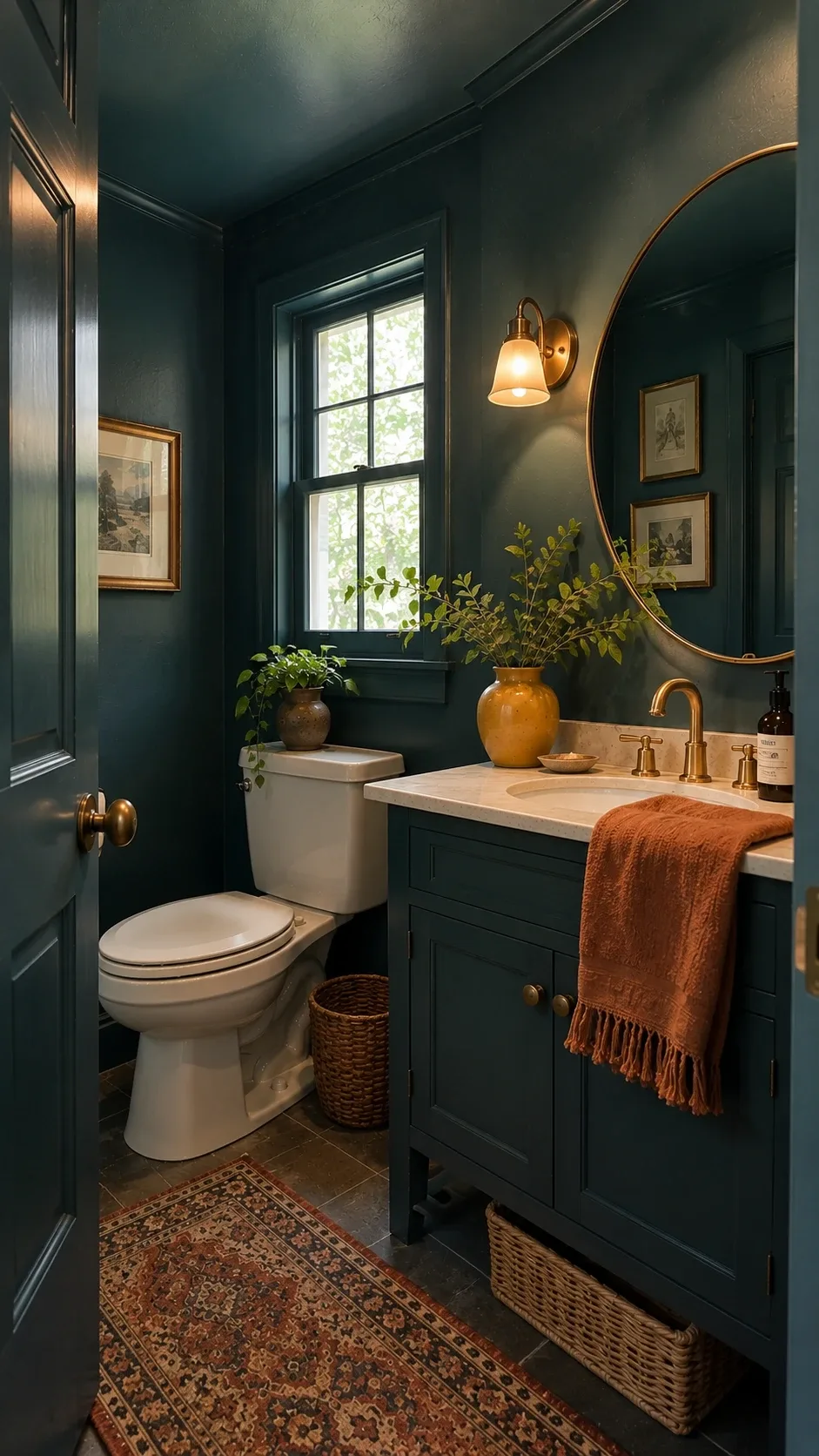
Color drenching means painting the walls, trim, baseboards, and ceiling in the same color family — either one shade or closely related tones with different finishes. In a powder room, this creates a cocoon effect that feels intentional and enveloping instead of chopped up.
I was terrified to paint the ceiling dark, but it turned out to be the single best decision in my powder room. The trick is varying the finish: matte on the walls, satin on the trim, so the light hits each surface differently. Deep green (Farrow & Ball’s “Studio Green” is the famous one) and chocolate brown are the most forgiving colors for this technique.
Floor and ceiling drama
6. Black-and-cream checkerboard floor
A checkerboard floor lets you keep the walls dark while giving the room a graphic punch. Black with warm cream (not stark white) feels softer and more traditional. Keep the tile size proportional — in a typical powder room, medium squares look best; tiny tiles get visually busy and oversized ones overwhelm the floor.
If retiling is too much, consider peel-and-stick floor tiles. I laid them in my old apartment’s powder room in an afternoon, and they held up for two years. Just make sure the subfloor is clean and level, and seal the edges with a bathroom-safe caulk.
7. Dark wood ceiling with warm stone walls
Nobody looks up in a powder room until they do — and then a dark wood ceiling stops them in their tracks. It adds drama overhead while letting the walls stay lighter (creamy stone or warm plaster), so the room never feels heavy. This look is especially good in older homes, where the natural grain and knots feel like they’ve always been there.
Use properly sealed wood rated for bathroom moisture, and don’t skimp on ventilation. A quiet, good-quality exhaust fan (Panasonic makes excellent whisper-quiet ones) protects both the wood and your paint.
Statement fixtures that do the heavy lifting
8. A dramatic stone sink as the focal point
A carved stone vessel sink — with visible mineral variation and an irregular edge — can carry an entire powder room. When the sink is this interesting, everything else can stay simple: a plain wood vanity, a basic mirror, one small accessory. Too many competing textures in a small room reads as clutter, not luxury.
Seal porous stone exactly as the manufacturer says, and test your faucet and drain before you finish the pretty stuff. I once installed a gorgeous travertine basin only to discover the drain assembly leaked — pulling it all apart again taught me to test first, admire later.
9. Reclaimed wood vanity with a vintage mirror
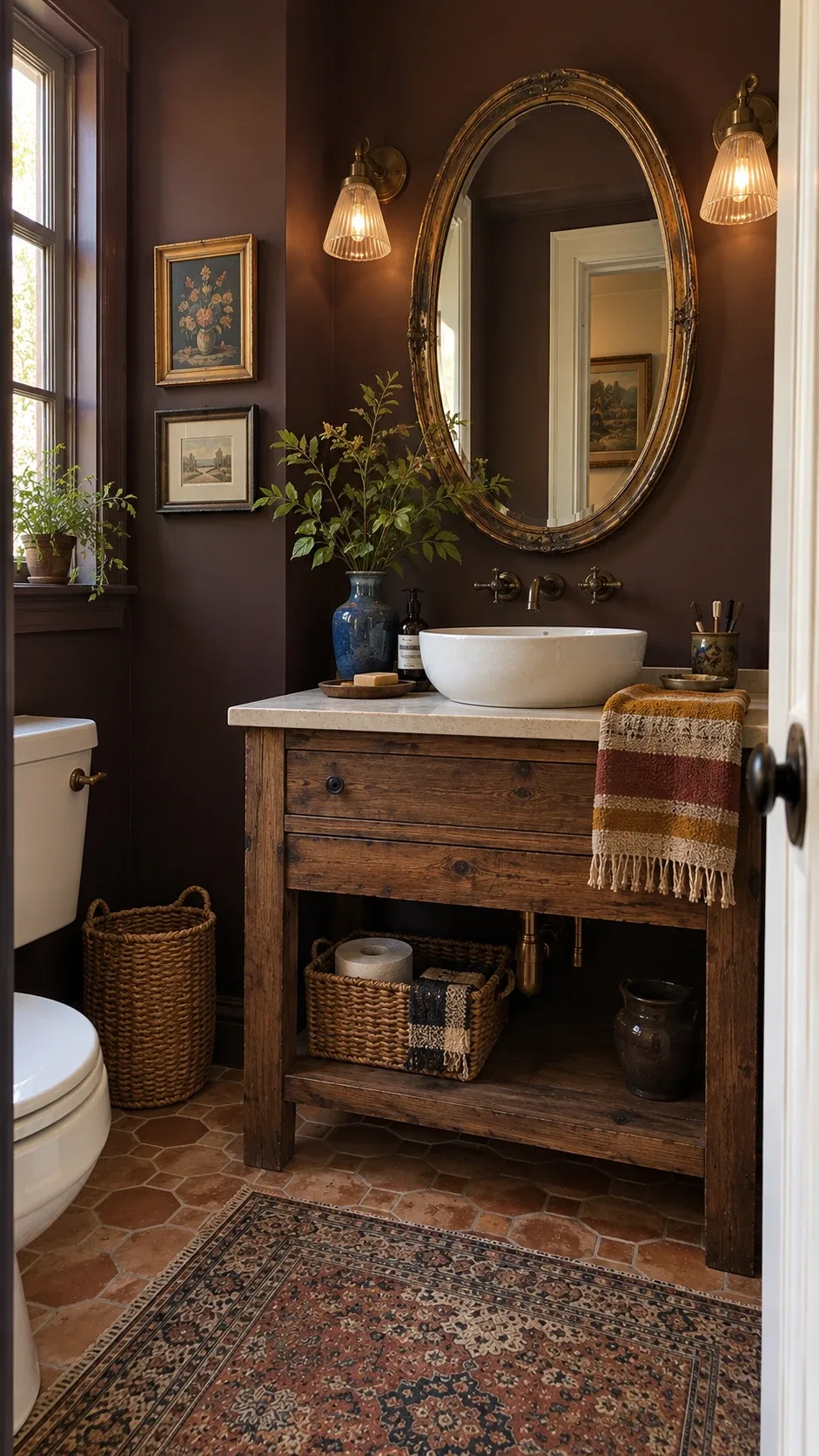
Reclaimed wood brings warmth and history to a dark bathroom — the knots, scratches, and tonal changes make the room feel collected over time rather than bought as a matching set. Pair it with a vintage or vintage-style mirror, and keep the countertop almost clear: one soap dispenser and one small object is plenty.
Seal reclaimed wood thoroughly with a waterproof finish, and confirm the piece is structurally solid enough for plumbing. Flea markets and salvage yards are goldmines for these — I found mine for $60 and spent a weekend sanding and sealing it.
10. Near-black monochrome with one cobalt accent
An almost entirely black bathroom — black walls, dark vanity, dark floor — becomes unforgettable with a single vivid accent. One handmade cobalt-blue ceramic vase or bowl, placed where the light hits it, breaks the palette in the most deliberate way. The rule is strict: the accent appears exactly once. Repeat it and the magic disappears.
Vary the sheens of your blacks (matte walls, satin vanity, glossy tile) so the monochrome has depth even before the accent arrives. This is the most fashion-forward look on the list, and guests will absolutely ask about it.
The details that sell the whole thing
11. A compact gallery wall on deep green
A powder room is the perfect place for a small gallery wall, because the art can be purely decorative. Deep forest green is a stunning backdrop for vintage prints, botanical drawings, or small landscapes. Use frames with a consistent finish so the collection feels curated, and lay the arrangement on the floor first before making a single hole.
Keep art away from splash zones, and include one slightly larger piece as an anchor. Thrift stores are full of perfect small frames — I built my entire gallery wall for under $40.
12. Sculptural lighting as the main event
In a windowless powder room, lighting shouldn’t be an afterthought — it should be the jewelry. A sculptural sconce or a pair of decorative fixtures flanking the mirror adds character and, just as importantly, puts flattering light on faces. A single overhead light creates harsh shadows; light at mirror height is infinitely kinder.
Match your fixture’s metal finish to your faucet and hardware for a pulled-together look. And always, always choose warm bulbs — 2700K is the sweet spot for moody spaces. Cool daylight bulbs will undo all your atmospheric work in one flip of the switch.
13. Moody wallpaper above dark wainscoting — the renter-friendly remix
Worth mentioning twice because it’s the most forgiving moody move: patterned wallpaper up top, dark painted wainscoting below. In busy family homes it’s the practical choice — little hands and scuffs hit the lower wall, and painted wood wipes clean while wallpaper stays pristine above the chair rail.
Pick a wallpaper whose colors echo your floor or countertop so the transition feels seamless. This was the look that finally made my powder room feel “done,” and it’s the one I’d recommend to anyone nervous about going dark.
Your weekend game plan (the order that actually works)
If you’re doing this over a weekend, sequence matters. Here’s the order that saved me from redoing work:
- Friday evening: Clear the room, remove the mirror and light fixture, and patch any wall damage. Pick your paint color with sample boards under the real lighting.
- Saturday morning: Paint the ceiling first, then walls, then trim. Two coats, bathroom-rated paint (eggshell or satin for wipeability). Let it cure while you work on other things.
- Saturday afternoon: Install wallpaper or wainscoting if your plan includes it. Hang it after paint, not before.
- Sunday morning: Swap the light fixture and install the mirror. This is when the room suddenly looks expensive — good lighting transforms dark paint instantly.
- Sunday afternoon: Set the vanity styling: one soap dispenser, one small vase or plant, a folded hand towel. Stop there. The biggest mistake in small moody rooms is adding “just one more thing.”
Mistakes I made so you don’t have to
Going dark without fixing the lighting first. My black-wall phase failed mostly because I kept the original harsh overhead light. Moody paint needs warm, layered light. Fix the light before you judge the color.
Choosing a blue-black for a windowless room. It looked chic on the swatch and icy in real life. Warm-based darks — charcoal with brown undertones, olive, oxblood — are far more forgiving under artificial light.
Cluttering the vanity. A dark room with a crowded countertop feels cramped; the same room with a clear countertop feels like a boutique hotel. Edit ruthlessly. If you need storage, a small basket on a shelf beats five bottles on the sink.
Forgetting the fifth wall. Leaving a bright white ceiling in an otherwise moody room breaks the spell every time you glance up. Paint it, even if it’s just a softer shade of the wall color.
Skipping the exhaust fan upgrade. Dark paint and wallpaper show moisture damage faster than light finishes. A good fan is unglamorous insurance — run it during every shower in the adjacent bath and for 20 minutes after.
A moody half bathroom is one of the highest-impact, lowest-cost transformations in a home. It’s a small canvas, so every bold choice counts double — and every mistake is cheap to fix. Pick the one idea that made your heart beat a little faster, start with the lighting, and give yourself the powder room that makes guests linger a minute longer than they planned to.